 listicle
Is Emergency Plumbing Covered by Home Insurance?
Table of Contents
- Sudden vs Gradual Plumbing Damage: What Insurers Cover
- What Standard Home Insurance Covers for Emergency Plumbing
- Common Plumbing Exclusions You Need to Know
- Home Insurance vs. Home Emergency Cover: Key Differences
- The Plumbing Insurance Claim Process Step by Step
- Emergency Plumbing Repair Costs and Deductible Analysis
- Policy Endorsements and Riders That Fill the Gaps
- Preventative Maintenance and Your Coverage
- Frequently Asked Questions
Last Updated: September 16, 2026
Sudden vs Gradual Plumbing Damage: What Insurers Cover
Home insurance generally covers emergency plumbing only when damage is sudden and accidental, not when it results from long-term wear and tear. That distinction decides almost every plumbing claim in Canada. This guide from UMark Plumbing and Drain Inc. explains where coverage starts and stops.
Why Gradual Deterioration Is Almost Always Excluded
Policies exclude gradual deterioration because it is predictable and preventable. A pipe leaking behind a wall for eight months did not fail suddenly; it was failing the whole time.
What Standard Home Insurance Covers for Emergency Plumbing
Standard home insurance covers the water damage an emergency plumbing failure causes, not the plumbing part that failed, the most misunderstood point in the claims process.
Water Damage vs. the Pipe Itself
Water damage is damage to your home and contents caused by water escaping from a plumbing system. The pipe itself is the component that failed. Most policies pay for the first and exclude the second.
In practice, that means:
- A burst pipe soaks your drywall, flooring, and furniture: the resulting property damage is typically covered.
- The burst pipe itself, plus the labor to reach and replace it: typically your cost.
- Mold remediation, once it is a direct result of a covered escape of water: often covered, though timelines and limits vary.
- Sewer backup or sump overflow: usually requires a separate endorsement.
Insurance Bureau of Canada guidance on home insurance basics
Common Plumbing Exclusions You Need to Know
Plumbing exclusions cluster around maintenance, age, and predictability. If a failure was foreseeable with routine care, expect the policy to step back.
The exclusions that catch homeowners most often:
- Wear and tear. Long-term deterioration of pipes, seals, and fixtures is excluded across virtually every standard policy.
- Seepage over time. Water that has been entering gradually, even if you only just noticed it, is treated as gradual damage.
- Freezing of an unheated building. Pipes that freeze because a property was left unheated may be excluded entirely.
- Faulty workmanship. If a previous repair or installation was done incorrectly, the resulting failure is usually excluded.
- Root intrusion and blockages in drainage lines. A blocked drain that backs up is not the same as a burst pipe.
- Failure to mitigate. If you noticed water and did nothing, the insurer can reduce or deny the claim.
Home Insurance vs. Home Emergency Cover: Key Differences
Home insurance and home emergency cover solve two different problems. Standard home insurance protects your property from damage. Home emergency cover pays for the repair itself, including parts and labor, and typically dispatches an approved contractor.
| Feature | Standard Home Insurance | Home Emergency Cover |
|---|---|---|
| Pays for the failed pipe | Rarely | Usually |
| Pays for resulting water damage | Usually | Limited |
| Covers emergency call-out labor | No | Yes |
| Contractor network provided | No | Yes |
| Typical trigger | Sudden and accidental | Sudden system failure |
| Separate premium required | No | Yes, an add-on |
The Plumbing Insurance Claim Process Step by Step
The claim process rewards homeowners who document first and repair second. Most denied claims fail not because the damage was excluded, but because the homeowner could not prove when and how the failure happened.
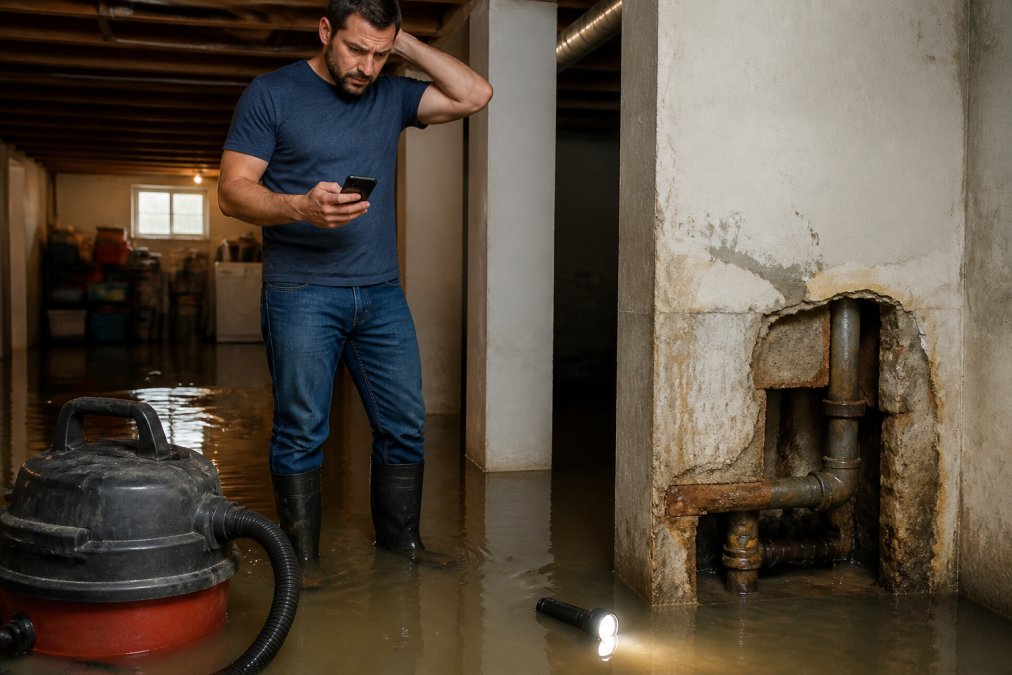
- Stop the water. Shut off the main supply valve and, if you can safely reach it, isolate the affected line.
- Document everything. Photograph and video the failure point, the standing water, and every damaged item before anything is moved.
- Call your insurer. Report the loss and get a claim number. Ask whether they want an adjuster to attend before repairs begin.
- Mitigate further damage. Extract standing water, run dehumidifiers, and move contents to a dry area. Insurers expect reasonable steps, not a finished repair.
- Get the plumbing repair quoted. Keep the emergency repair and the restoration work as separate line items.
- Meet the adjuster. Walk them through the failure point and your documentation.
- Keep every receipt. Emergency call-out, drying equipment rental, and temporary accommodation all belong in the file.
Documentation Checklist for Your Claim
- Photos of the failure point before repair
- Video walkthrough showing water extent and depth
- Date and time the failure was discovered
- Plumber's written assessment naming the cause
- Itemized repair quote separating plumbing from restoration
- Receipts for emergency work and equipment rental
- Inventory of damaged contents with replacement values
- Any prior maintenance records for the affected system
Emergency Plumbing Repair Costs and Deductible Analysis
Most articles stop at "compare the repair to your deductible." That advice is incomplete: the number that matters is not the repair cost but the covered portion of the loss, which is almost always smaller than the invoice in your hand.
Step 1: Split the invoice into covered and uncovered portions
Ask your plumber to itemize the work into two buckets:
- The plumbing repair itself, cutting out the failed section, replacing the fitting, restoring access through drywall or concrete. This is almost always your cost.
- The resulting water damage, extraction, drying equipment, dehumidification, replacing soaked flooring, drywall, insulation, and contents. This is the portion a standard policy may pay.
Step 2: Subtract your deductible from the covered portion only
If your covered water damage is $4,000 and your deductible is $2,500, the claim is worth $1,500 before any premium impact. If your covered damage is $2,000 and your deductible is $2,500, the claim pays nothing, and it still goes on your claims history.
Step 3: Ask your broker about the premium impact before you file
A claim does not just cost you the deductible, it can affect your renewal rate, claims-free discount, and even insurability. Your broker can tell you what a claim of this size has done to comparable policies.
Ask specifically:
- Will this claim affect my claims-free discount at renewal?
- For how many years does a claim stay on my record with this insurer?
- Is there a threshold below which the insurer would rather I pay out of pocket?
Step 4: Compare the three-year cost, not the one-year cost
Pay out of pocket = full repair cost, no premium change, no claims record.
A quick rule of thumb
If the covered water damage is only marginally above your deductible, paying out of pocket and preserving your claims history is usually the better financial move. If the covered damage is several times the deductible, file. In the gray zone, a five-minute call to your broker beats any online calculator.
Policy Endorsements and Riders That Fill the Gaps
Endorsements and riders are optional add-ons that extend a standard policy to cover what it otherwise excludes. For plumbing, they are the difference between a policy that covers the cleanup and one that covers the cleanup plus the repair that caused it. Most homeowners never ask about them, which is why the gaps surface at the worst possible moment.
Service line coverage
What it covers: The buried water and sewer lines running between your home and the municipal connection, the portion of the system that is your responsibility but sits outside your foundation.
Sewer backup endorsement
What it covers: Damage caused when a drain or sewer line backs up into your home, typically from a municipal surcharge, a blockage, or a combined storm-and-sanitary system overload.
Home emergency cover
What it covers: The repair of the failed plumbing itself, parts and labor, plus emergency call-out, and usually access to a vetted contractor network.
Overland water and groundwater coverage
What it covers: Water that enters your home from the surface, overland flooding, storm surge, or groundwater seepage, rather than from a plumbing failure.
Increased mold remediation limits
What it covers: Raises the default cap on mold cleanup, which is often a small fraction of what full remediation actually costs.
The caveat that applies to all of them
Endorsements extend what is covered, not when. They rarely override the wear and tear exclusion: a corroded pipe is still a corroded pipe, whichever rider you buy, and the gradual-deterioration exclusion still governs whether the loss is claimable.
How to decide which ones to buy
Work through your home's risk profile rather than buying every rider on offer:
- Age and material of your plumbing. Older galvanized or polybutylene systems raise the odds of a sudden failure, which raises the value of home emergency cover.
- Basement or finished lower level. Any finished space below grade makes sewer backup and overland water coverage far more valuable.
- Service line age and tree proximity. Original lines with mature trees nearby make service line coverage a rational purchase.
- Prior water events. A history of leaks or dampness makes increased mold limits worth pricing.
Preventative Maintenance and Your Coverage
What actually moves the needle:
- Have the main shut-off valve exercised and the supply lines inspected annually.
- Replace rubber supply hoses on washing machines and dishwashers on a set schedule rather than waiting for failure.
- Insulate pipes in unheated areas before the first hard freeze.
- Address slow drains and small drips immediately; they are the early warning of the failures insurers exclude.
- Keep a dated log of every inspection and repair.
When a failure does happen, response time matters as much as the paperwork. UMark Plumbing and Drain Inc. has handled emergency leaks, burst pipes, and drainage failures for more than 20 years, with certified technicians available around the clock for residential and commercial properties. One customer put it simply: the technician arrived on time, provided an estimate, and fixed the problem right away.
Frequently Asked Questions
Does standard home insurance cover sudden pipe bursts?
Yes, most standard home insurance policies cover sudden and accidental pipe bursts. This includes the water damage caused by the burst, such as ruined flooring, drywall, and belongings. However, the cost to repair or replace the pipe itself is often excluded. You would need to check your policy wording or add emergency plumbing coverage to handle the repair cost.
Is water damage from a slow leak covered by insurance?
Water damage from a slow leak is typically not covered because insurers classify it as gradual deterioration or wear and tear. Policies require damage to be sudden and accidental. If a slow leak has been ongoing for weeks or months, the resulting mold, rot, and structural damage will likely be denied. Preventative maintenance is key to avoiding this situation.
What plumbing issues are considered 'emergency' by insurance providers?
Insurers generally consider a plumbing issue an emergency when it is sudden, accidental, and causes immediate property damage. Examples include a burst pipe flooding a room, a failed water heater leaking heavily, or a blocked drain causing sewage backup. Routine clogs, dripping faucets, and slow leaks are not emergencies and are excluded from standard coverage.
Does home insurance cover the cost of a plumber's emergency call-out fee?
Standard home insurance usually does not cover the plumber's call-out fee or labor to fix the pipe. It covers the resulting water damage instead. However, if you have a home emergency cover endorsement or a service line coverage add-on, the call-out fee and repair labor may be reimbursed. Check your policy or ask your provider for details.
How do I file a plumbing insurance claim for water damage?
First, stop the water and call a licensed plumber for emergency repairs. Then document everything with photos and videos, and keep all receipts. Contact your insurer within the timeframe stated in your policy. An adjuster will assess the damage. Provide a detailed list of damaged items and the plumber's report. The claim process typically takes a few weeks.