 listicle
How to Decide if Touchless Kitchen Faucets Are Worth It
Last Updated: October 30, 2026
Quick Summary
Touchless kitchen faucets start and stop water with a motion sensor instead of a handle, removing one high-touch point and stopping a forgotten running tap. Expect modest, habit-dependent water savings, since false triggers can waste water and flow rate is set by the aerator, not the sensor.
- Buy a touchless faucet for convenience and hygiene, not for a water-bill payback.
- Choose a model with adjustable sensor range and a manual override or bypass.
- Confirm under-sink room for the solenoid and battery pack before ordering.
- Touch-activated models are cheaper and more predictable but still require contact.
- Hard water scale threatens both the aerator and the solenoid valve.
Table of Contents
- How Do Touchless Kitchen Faucets Work?
- Hygiene and Germ Transfer: What the Hands-Free Handle Actually Changes
- Water Conservation and Automatic Shutoff: What You Can Realistically Expect
- Touchless Kitchen Faucet Pros and Cons
- Touchless vs. Touch-Activated Kitchen Faucets
- Touchless Kitchen Faucet Installation: What to Check Before You Buy
- Book a Faucet Installation Quote
- Frequently Asked Questions
How Do Touchless Kitchen Faucets Work?
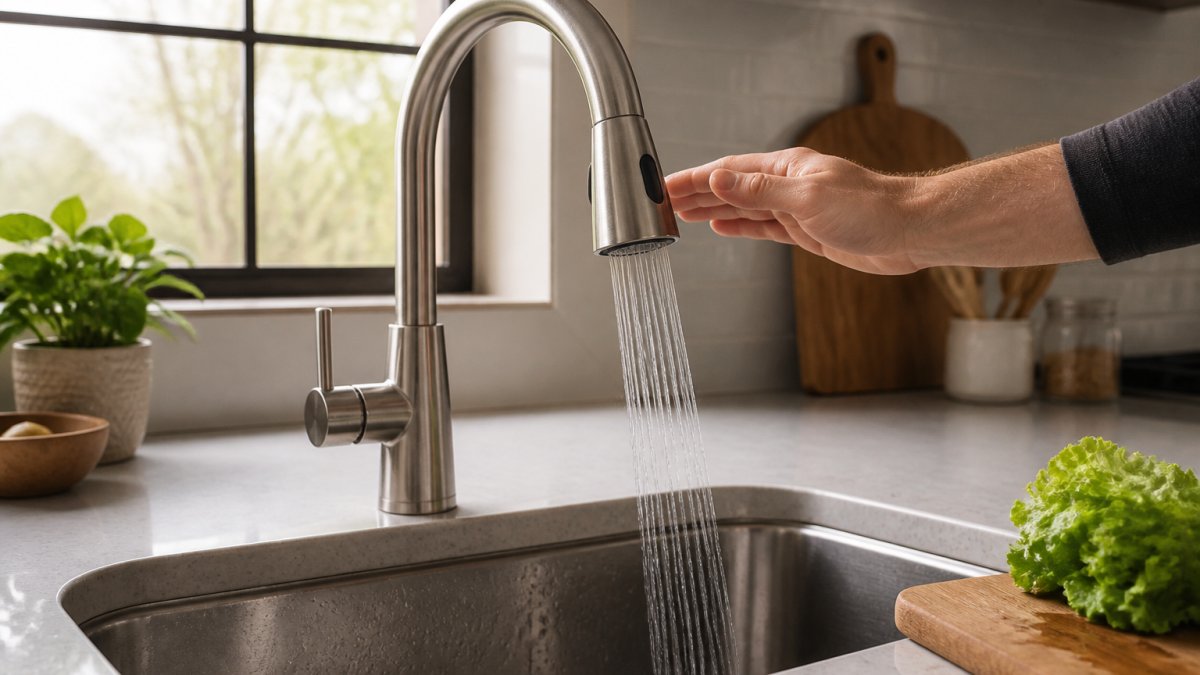
A touchless kitchen faucet is a fixture that starts and stops water flow using a motion sensor rather than a physical handle, so your hands never touch the unit while they are dirty.
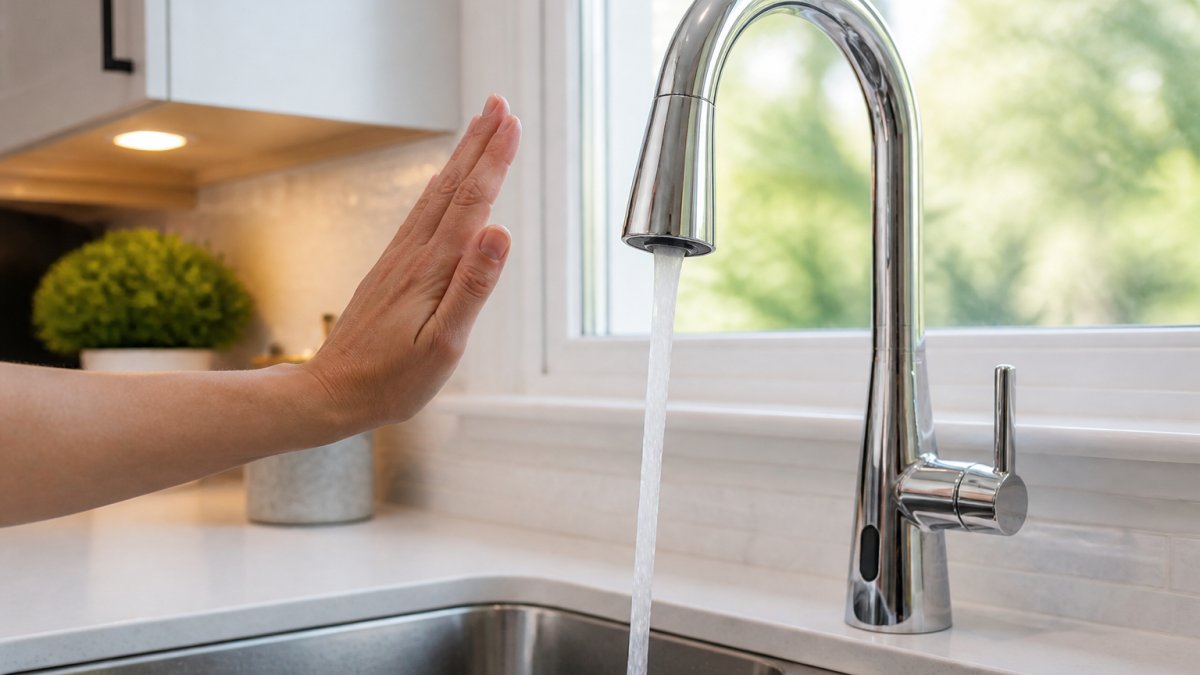
Here is the basic sequence. When your hands leave the zone, the valve closes. How infrared sensor faucets work describes the underlying detection principle, which is the same one used in automatic doors and hand dryers.
Sensor Types, Activation Range, and Power Sources
Most units use either an infrared sensor or, less commonly, a capacitive touch strip along the neck. Infrared models react to anything in the detection zone, including a passing sleeve or a pet.
Activation range matters more than most buyers expect. A narrow sensor zone reduces false triggers but forces you to find the sweet spot with wet hands. A wide zone is easier to use but can trip when you reach for the soap.
Power comes from one of three sources:
- Battery: easiest to retrofit, but you will be changing cells at intervals that depend on how often the kitchen is used
- AC adapter: no battery swaps, but you need an outlet under the sink
- Hardwired or hybrid: the most reliable, and the most work to install
Hygiene and Germ Transfer: What the Hands-Free Handle Actually Changes
The hygiene benefit is narrower than the marketing often suggests. A touchless faucet removes one high-touch point from the kitchen, and that point is genuinely dirty: raw meat residue, grease, and soil all end up on a manual handle.
What it does not do is sanitize anything. The spout, the aerator, and the sink basin still collect bacteria, and those parts need the same cleaning routine as any other faucet. Health Canada guidance on safe food handling is a better source of practical hygiene advice than any faucet brochure, because cross-contamination in a kitchen comes from cutting boards, cloths, and hands far more than from a handle.
If you plan to pair the faucet with filtered water, our guide to water filtration system cost for homes breaks down what a system adds to the project.
Water Conservation and Automatic Shutoff: What You Can Realistically Expect
Automatic shutoff is the feature that sounds best on paper and delivers the least in practice. The valve closes when your hands leave the sensor zone, which stops a running tap you walked away from.
The catch is that touchless faucets are not classified as water conservation devices. Best Management Practice #7 on faucets and showerheads notes that sensor faucets can actually waste water, because a false trigger or a wave in the wrong spot starts a flow that would not have happened with a handle.
Where the water actually goes
A touchless faucet changes when water runs, not how much flows per minute. Flow rate is set by the aerator and the model's rated flow. So the only way a touchless unit saves water is by shortening the total minutes the tap is open. Three scenarios drive most of the difference:
- The forgotten tap. A manual faucet left running for two minutes while you answer the door wastes far more than any sensor misfire. This is the case where touchless genuinely wins.
- The rinse-and-reach. If you currently turn the handle on, rinse, turn it off, and repeat, a touchless model may run longer per task because the sensor keeps the valve open whenever your hands are in range.
- The false trigger. Steam from a boiling pot, a passing sleeve, or a pet can start a flow. A poorly placed sensor in a busy kitchen can erase the savings from the forgotten-tap scenario entirely.
A realistic way to think about the water bill
Do not build a budget around a water-bill reduction. Treat any reduction as a bonus, not a payback calculation.
What you can control is the waste side. If you buy touchless, choose a model with an adjustable sensor range and, where available, a sensitivity setting, so you can tune out steam and nearby movement. Mount the sensor away from the stove side of the sink if your layout allows.
If you are also considering filtered water at the sink, our guide to water filtration system cost for homes explains what that adds to the project and how it interacts with faucet choice.
Touchless Kitchen Faucet Pros and Cons
Here is the honest trade-off, in the form most of our customers find useful.
| Factor | Advantage | Drawback |
|---|---|---|
| Convenience | No handle to touch with messy hands | Sensor can misfire on steam or movement |
| Hygiene | Removes one high-touch point | Spout and aerator still need cleaning |
| Water use | Automatic shutoff stops a forgotten tap | False triggers can waste water |
| Power | Battery models retrofit easily | Battery changes and outlet needs |
| Cost | Long service life on quality models | Higher upfront price than manual |
| Repair | Simple solenoid replacement in most cases | Sensor faults can be hard to diagnose |
The pros are practical and the cons are manageable, which is why we recommend them selectively rather than universally. If you have hard water, mineral scale is the main threat to both the aerator and the solenoid valve, so read our roundup of the best kitchen faucet brands for hard water before you commit to a model.
Best for: households that cook with raw meat often, or anyone with limited hand strength who finds a lever handle awkward. Skip if: you want the lowest possible purchase price or you rent and cannot change the plumbing.
Touchless vs. Touch-Activated Kitchen Faucets
The distinction trips up a lot of buyers. A touch-activated faucet responds to contact anywhere on the spout or handle, usually a tap from a wrist or forearm. A true touchless model never needs contact at all.
Which is better depends on one question: do you want the water to start when your hands are full?
- Touch-activated is more predictable, cheaper, and less prone to false triggers. It still requires you to touch the fixture, so it does not fully solve the dirty-hands problem.
- Touchless is the better choice for messy prep work and for anyone who struggles with a stiff lever. It costs more and demands a reliable power source.
Touchless Kitchen Faucet Installation: What to Check Before You Buy
Installation is where most disappointment happens, and it has nothing to do with the faucet's quality. A touchless model needs three things a manual faucet does not: a power source, clearance for a larger control box under the sink, and a sink deck hole that matches the unit's footprint.
Check these before you order:
- Measure the deck hole diameter and confirm it matches the faucet spec
- Confirm there is room under the sink for the solenoid and battery pack
- Decide on battery, adapter, or hardwired power and locate the outlet
Plan for failure before it happens
A touchless faucet is an electronic fixture, and electronics fail. The difference between a frustrating ownership experience and a manageable one is whether you planned for the failure modes before the install:
- Battery failure. Most battery-powered units give a low-battery warning (a blinking light or a beep), but not all do. Know where the battery pack is, keep a spare set on hand, and check the warning behavior in the manual before you commit.
- Power interruption. An AC-adapter model stops working when the outlet loses power. If the outlet is on a switched circuit or a GFCI that trips, you can lose faucet function without warning. Confirm the outlet is dedicated and unswitched.
- Sensor malfunction. A dirty sensor window, mineral film, or a failed sensor board can cause the valve to stay open or refuse to open. Look for a model with a manual handle or a bypass mode so the faucet still works as a conventional fixture.
- Stuck solenoid valve. Scale and debris are the usual culprits. A valve that sticks open is a water-damage risk, not just an inconvenience, so a manual shutoff under the sink is worth having regardless of the faucet model.
What the install actually costs in Canadian dollars
Budget for more than the faucet sticker price. Pricing depends on brand, finish, sensor features, and the installation work involved, such as whether an outlet must be added or the deck hole enlarged. For current prices or a quote, see the UMark Plumbing and Drain Inc. pricing page. Battery replacement is a small recurring cost; an AC adapter or hardwired option trades that for an electrician's visit if no outlet exists.
If you are weighing whether to do it yourself, our article on whether you can replace a sink without a plumber covers the parts of the job that go wrong most often.
Book a Faucet Installation Quote
The decision comes down to your kitchen, your water, and how you cook.
At UMark Plumbing and Drain Inc., we offer plumbing services with over 20 years of experience. Our certified team can help with your plumbing needs. We offer 24/7 service.
You can review our plumbing services near me offering or our dedicated plumbing repair in North York page to see how we work and what to expect on the day.
Frequently Asked Questions
Are touchless kitchen faucets worth the extra cost?
It depends on how you cook and clean. You pay a price premium over a standard faucet, plus battery or power adapter costs over time. In exchange you get hands-free operation when your hands are covered in grease or food residue, fewer touches on a dirty handle, and automatic shutoff that limits water waste. For busy households, families with young children, or anyone who preps raw meat often, the long-term value is easier to justify. Get a quote for installation before you commit.
Does a touchless faucet need power?
Yes, but not necessarily a wall outlet. Most models are battery-powered, using AA or lithium batteries that typically last several months to a couple of years depending on use. Some units can be plugged into an outlet under the sink with an adapter, and a few offer both options. Battery life drops with heavy daily use and cold kitchen temperatures. Check the power source before buying, and keep spare batteries on hand so the sensor does not fail mid-cooking.
Are touchless and touch-activated kitchen faucets the same?
No. A touchless faucet uses a motion sensor to start and stop water when your hand enters the activation range, with no contact at all. A touch-activated faucet needs a physical tap anywhere on the spout or handle to turn the water on and off. Touch-activated models cost less and avoid false triggers, while touchless models offer full hands-free operation. The right choice depends on whether hygiene or budget matters more in your kitchen.
What should you check before installing a touchless kitchen faucet?
Confirm the number of sink holes, the deck thickness, and the distance to the backsplash, because sensor faucets need clearance and a control box that fits under the sink. Check that your under-sink space has room for the battery pack or adapter and that your water pressure is adequate. Also verify the faucet's sensor range suits your sink depth so it does not trigger when you reach for a sponge. A certified plumber can confirm sink compatibility before you buy.
A touchless faucet is a good upgrade when the fit is right and a frustrating one when it is not, and the difference usually comes down to installation details rather than the fixture itself. If you want the job checked properly the first time, get a free quote from UMark Plumbing and Drain Inc. and we will confirm compatibility, power, and placement before anything is ordered.