 listicle
7 Best Kitchen Faucet Brands for Hard Water
Table of Contents
- Why Hard Water Changes Which Faucet You Should Buy
- How We Chose the Best Kitchen Faucet Brands for Hard Water
- The 7 Best Faucet Brands for Hard Water
- Moen: The Best Overall Faucet Brand for Hard Water
- Kohler: The Best Faucet Brand for Durability and Design
- Delta: The Best Faucet Brand for Value and Parts Availability
- Kraus: The Best Faucet Brand for Spot Concealment
- American Standard: The Best Faucet Brand for Budget-Minded Buyers
- Grohe: The Best Faucet Brand for European Styling
- Hansgrohe: The Best Faucet Brand for Premium Spray Performance
- The Best Faucet Finish for Hard Water
- How to Remove Hard-Water Buildup from a Faucet
- Kohler vs. Moen Kitchen Faucets: Which Handles Hard Water Better?
- Hard-Water Faucet Maintenance That Prevents Costly Repairs
- Frequently Asked Questions
Last Updated: October 19, 2026
Why Hard Water Changes Which Faucet You Should Buy
Hard water leaves mineral deposits on everything it touches, and your kitchen faucet takes the worst of it.
At UMark Plumbing and Drain Inc., we have spent more than 20 years repairing and replacing fixtures, and we see the same pattern repeatedly: buyers pick a faucet for its finish, then discover the cartridge has scaled up and the spray nozzles have crusted over.
How We Chose the Best Kitchen Faucet Brands for Hard Water
We scored each brand on the criteria that decide how a faucet survives hard water, not on showroom appeal. The shortlist weighs cartridge type, spray head design, finish options, parts availability, and warranty support.
Our scoring criteria, in order of weight:
- Cartridge durability: ceramic disc designs resist scale seizure better than rubber washers
- Spray nozzle design: rubber or silicone nozzles that you can rub clean by hand
- Finish range: at least one spot-resistant or brushed option
We did not rank on brand recognition alone. A cheaper faucet with an accessible cartridge and rubber nozzles often outlasts a premium model with hard-to-source parts.
The 7 Best Faucet Brands for Hard Water
Here are the faucet brands we recommend for hard-water homes, with the trade-offs that matter.
| Brand | Best For | Key Hard-Water Strength | Watch Out For |
|---|---|---|---|
| Moen | Best overall | Wide parts availability, ceramic cartridges | Some finishes spot easily |
| Kohler | Durability and design | Solid brass bodies, strong spray | Premium price |
| Delta | Value and parts | Easy cartridge swaps, broad retail reach | Finish range varies by model |
| Kraus | Spot concealment | Spot-free finishes | Fewer local parts sources |
| American Standard | Budget buyers | Reliable basics at lower cost | Fewer premium finishes |
| Grohe | European styling | Corrosion resistance | Parts can take longer to source |
| Hansgrohe | Premium spray | Refined spray nozzles, easy cleaning | Highest cost |
Moen: The Best Overall Faucet Brand for Hard Water
Moen is our top pick because replacement cartridges are easy to find and most models use ceramic disc valves that resist scale seizure. The Moen Adler single-handle high-arc pulldown is a strong example: a pull-down sprayer, high-arc spout, and a design that has earned top marks in independent kitchen-faucet testing.
Pros: widely stocked parts, clear warranty support, broad model range. Cons: some polished finishes show water spots quickly.
Kohler: The Best Faucet Brand for Durability and Design
Kohler faucets use solid brass bodies and finishes that hold up to daily use, which matters when mineral-heavy water is constantly on the surface. The Kohler Clarus pull-down is noted for durability and a strong spray, and the Edalyn by Studio McGee suits buyers who want a design-forward fixture and will pay for it.
Pros: strong construction, strong spray performance, design range. Cons: higher price, and premium finishes still need regular wiping.
Delta: The Best Faucet Brand for Value and Parts Availability
Delta sits in the sweet spot for value. The Classic pull-down line is widely available, cartridges are easy to source, and most repairs are straightforward. If you want a faucet you can fix rather than replace, Delta is a sensible choice.
Pros: affordable, easy parts access, simple cartridge swaps. Cons: finish and feature quality varies across the range.
Kraus: The Best Faucet Brand for Spot Concealment
Kraus earns its place on this list for one reason: spot-free finishes. In hard-water areas, a spot-resistant finish cuts down the visible white spotting that makes a faucet look dirty within a day. It is the brand to consider when appearance matters as much as function.
Pros: spot-free finish options, modern styling. Cons: fewer local parts sources, so plan ahead for replacements.
American Standard: The Best Faucet Brand for Budget-Minded Buyers
American Standard covers the basics well at a lower price. Cartridges and aerators are accessible, and the fixtures handle everyday use. It will not win a design award, but it is a practical pick for rentals and secondary kitchens.
Pros: lower cost, dependable core function. Cons: fewer premium finishes and spray features.
Grohe: The Best Faucet Brand for European Styling
Grohe brings European design and strong corrosion resistance, which helps in hard water. The trade-off is parts: replacements can take longer to source than domestic brands, so confirm local availability before you buy.
Pros: corrosion resistance, distinctive styling. Cons: slower parts sourcing, higher cost.
Hansgrohe: The Best Faucet Brand for Premium Spray Performance
Hansgrohe focuses on spray quality. Its nozzles are designed for easy cleaning, which is exactly what hard water demands. You pay for that refinement, but the spray head holds up better than budget alternatives.
Pros: refined spray, easy-clean nozzles. Cons: highest cost on this list.
The Best Faucet Finish for Hard Water
The best faucet finish for hard water is not simply the one that hides spots best, it is the one that balances two separate properties: resistance to corrosion and mineral attack, and how well it conceals the white spotting that hard water leaves behind.
Durability versus concealment, two different tests:
- Corrosion and mineral resistance determines how long the finish survives. Hard water deposits can pit or dull lower-quality finishes, especially at the base and around the spray head where water pools. Solid brass bodies with a properly applied finish resist this far better than zinc or plastic-bodied fixtures.
- Spot concealment determines how the finish looks day to day. A finish can be durable and still show every droplet, or fragile and still hide spotting well. Judge them separately.
Finish-by-finish, here is how the common options compare on both axes:
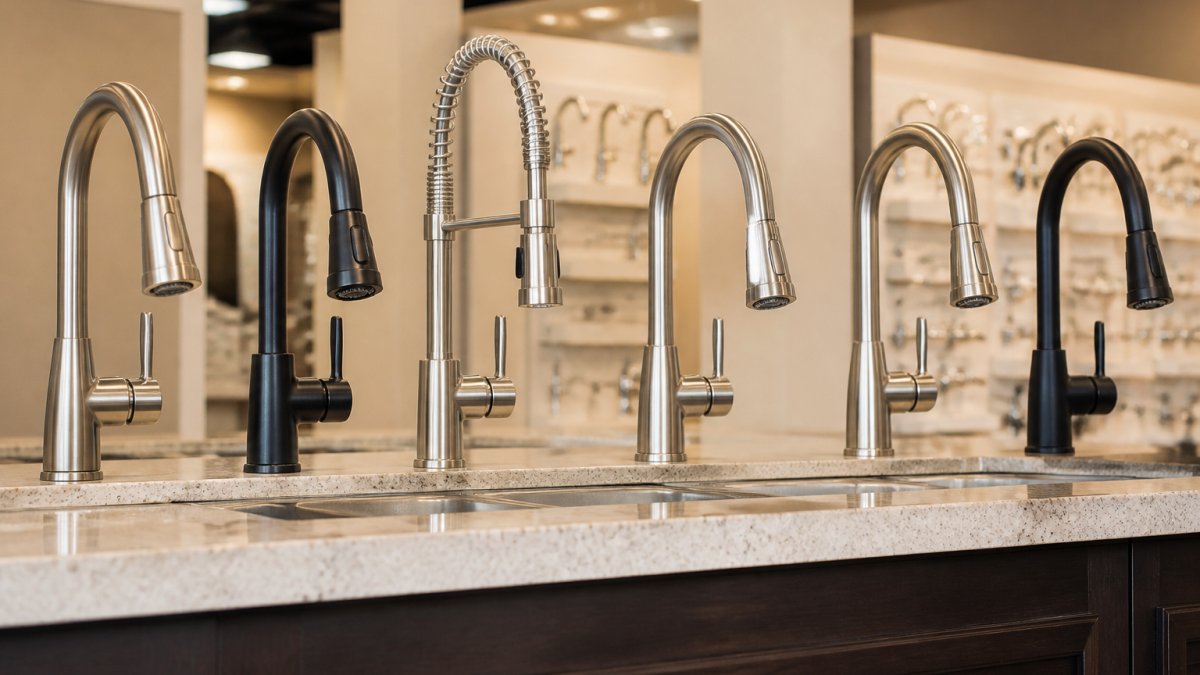
- Brushed nickel and brushed stainless: the strongest all-round choice. The brushed texture scatters light so dried droplets and faint mineral film are less visible, and both finishes resist corrosion well when applied over a solid brass body. Low daily upkeep.
- Spot-free or spot-resistant coatings: designed specifically to reduce visible water spotting, and effective at it. The trade-off is that the coating itself can be damaged by abrasive pads and harsh cleaners, so the concealment advantage depends on gentle cleaning.
- Polished chrome: highly corrosion-resistant and easy to wipe, but it shows every droplet and every dried mineral ring immediately. High upkeep, not low durability.
A practical way to decide: if your priority is not thinking about the faucet, pick brushed nickel or brushed stainless. If your priority is a specific look and you are willing to wipe daily, polished finishes are fine, just confirm the body material underneath, because the finish is only as durable as what it covers.
How to Remove Hard-Water Buildup from a Faucet
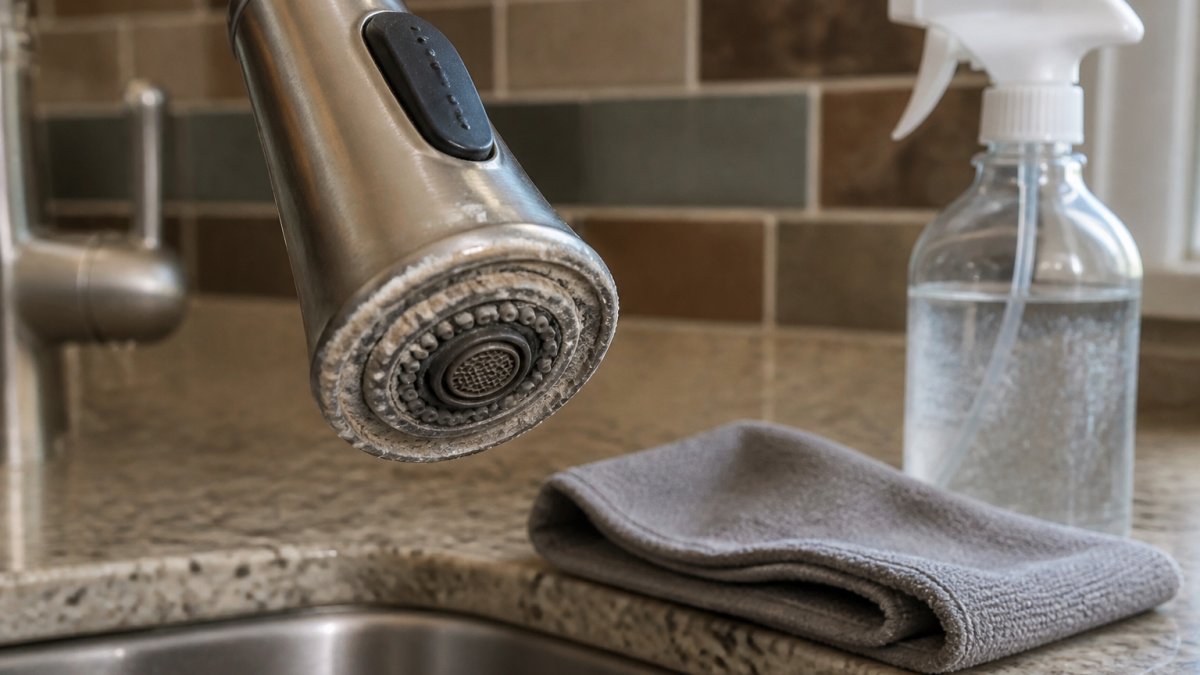
Hard-water buildup does not attack a faucet evenly. Calcium and magnesium carbonate settle wherever water sits still or evaporates, so the damage clusters in four places, each with its own failure mode and its own cleaning approach.
Where buildup forms and what it does:
- Aerator: the fine mesh screen at the spout tip traps mineral particles, and scale bridges the openings until flow drops or the stream sprays sideways. This is the most common and most fixable hard-water problem.
- Spray head and nozzles: on pull-down and pull-out models, scale crusts around each nozzle opening and can block individual jets, causing an uneven or weak spray. Rubber or silicone nozzles can often be cleared by rubbing them with a thumb; hard plastic nozzles need soaking.
- Cartridge: scale and grit work into the cartridge and valve seats, causing stiffness, drips, or a handle that will not move smoothly. This is where hard water turns a cleaning job into a repair.
A safe cleaning routine:
- Unscrew the aerator by hand or with a cloth-wrapped wrench, and remove the spray head where the model allows.
- Soak both in a 50/50 mix of white vinegar and water for about 30 minutes. For heavy limescale, repeat the soak rather than scrubbing harder.
- Scrub the aerator screen and nozzle openings with an old toothbrush or soft brush. Do not use a pin to poke nozzles, it can tear silicone.
- Rinse thoroughly and reinstall, checking that the aerator seats evenly so it does not leak at the threads.
- Wipe the body and spout dry with a microfiber cloth to prevent new film.
When cleaning is not enough: if flow stays weak after descaling, the aerator screen may be torn or the cartridge may be scaled internally. A replacement aerator is inexpensive and easy to fit; a cartridge swap is a slightly bigger job but still a DIY task on brands with accessible parts. If the handle is stiff or the faucet drips after cleaning, the cartridge, not the finish, is the part to replace.
Kohler vs. Moen Kitchen Faucets: Which Handles Hard Water Better?
Moen edges out Kohler for hard water because its cartridges are easier to source and replace, while Kohler wins on body durability and design. If self-service repairs matter, choose Moen. If you want a fixture that feels built to last and you accept the higher price, Kohler is the stronger choice.
The deciding factor is usually parts. A faucet is only as good as your ability to fix it when scale takes hold.
Hard-Water Faucet Maintenance That Prevents Costly Repairs
Hard-water faucet maintenance comes down to three habits: wipe the fixture dry daily, descale the spray head monthly, and replace the cartridge at the first sign of a drip. Those habits prevent the seized valves and clogged nozzles that turn a small fix into a fixture replacement.
A maintenance schedule that works:
- Daily: wipe the spout and handle dry
- Monthly: soak the aerator and spray head in vinegar
- Every few months: check for drips and slow spray
If a faucet is already leaking, seized, or spraying unevenly despite cleaning, the problem may be deeper than surface scale. Our certified team handles repairs and replacements across North York and Vaughan, with 24/7 emergency service when a leak will not wait. Health Canada's guidance on drinking water quality can help you understand what is in your water, and Natural Resources Canada's water efficiency resources explains why flow rate and aerator choice matter. For fixture standards, see CSA Group's plumbing product standards.
Frequently Asked Questions
Which brand of faucet is best for hard water?
Moen and Kohler are the strongest choices for hard-water areas. Moen's ceramic disc cartridges resist mineral buildup and its replacement parts are widely stocked, while Kohler's solid brass bodies and durable finishes hold up well. Kraus is worth a look if spot concealment matters most, thanks to its spot-free finish option. Whichever brand you choose, a brushed or matte finish and easy-clean spray nozzles will reduce visible limescale and make routine cleaning faster.
Which faucet finish shows the least hard-water spots?
Brushed finishes hide hard-water spots best. Brushed nickel, brushed gold and matte black scatter light instead of reflecting it, so white mineral deposits blend in. Polished chrome and polished stainless steel show every spot and need wiping after each use. If you want the lowest-maintenance option, pair a brushed finish with a spot-resistant coating and rinse the faucet weekly to stop limescale from bonding to the surface.
How do you remove hard-water buildup from a kitchen faucet?
Mix equal parts white vinegar and water, then soak a cloth in the solution and wrap it around the spray head and spout for 15 to 20 minutes. Rinse with warm water and wipe dry. For stubborn limescale around the aerator, unscrew it and soak it in vinegar overnight. Avoid abrasive pads and chlorine bleach, which can dull the finish. Repeat every two to three months in hard-water areas to keep mineral deposits from clogging the spray nozzles.
Is Kohler or Moen better quality for hard water?
Both brands use durable materials and ceramic disc cartridges. Kohler often uses solid brass bodies and offers a wider range of premium finishes, which helps in hard-water areas where corrosion resistance matters. Moen focuses on easy cartridge replacement and broad parts availability, so repairs are simpler and cheaper over time. For most households, Moen is the more practical pick; Kohler suits buyers who want a specific design and are willing to pay more upfront.
Can hard water damage a kitchen faucet?
Hard water does not destroy a faucet overnight, but mineral deposits build up inside the cartridge, aerator and spray head. Over time this restricts water flow, causes dripping and wears out seals faster. Limescale also etches some finishes and leaves permanent water spots. Regular cleaning, a water softener or a filtration system, and prompt cartridge replacement will extend the faucet's life and keep water pressure steady.
Hard water will test any faucet, but the right brand and a simple maintenance routine keep yours working for years. If mineral buildup has already caused a leak or a seized valve, UMark Plumbing and Drain Inc. can help. With over 20 years of experience, a certified team, and 24/7 emergency service, we repair and replace fixtures quickly and affordably. Get a free quote from UMark Plumbing and Drain Inc. and put your faucet problems behind you.