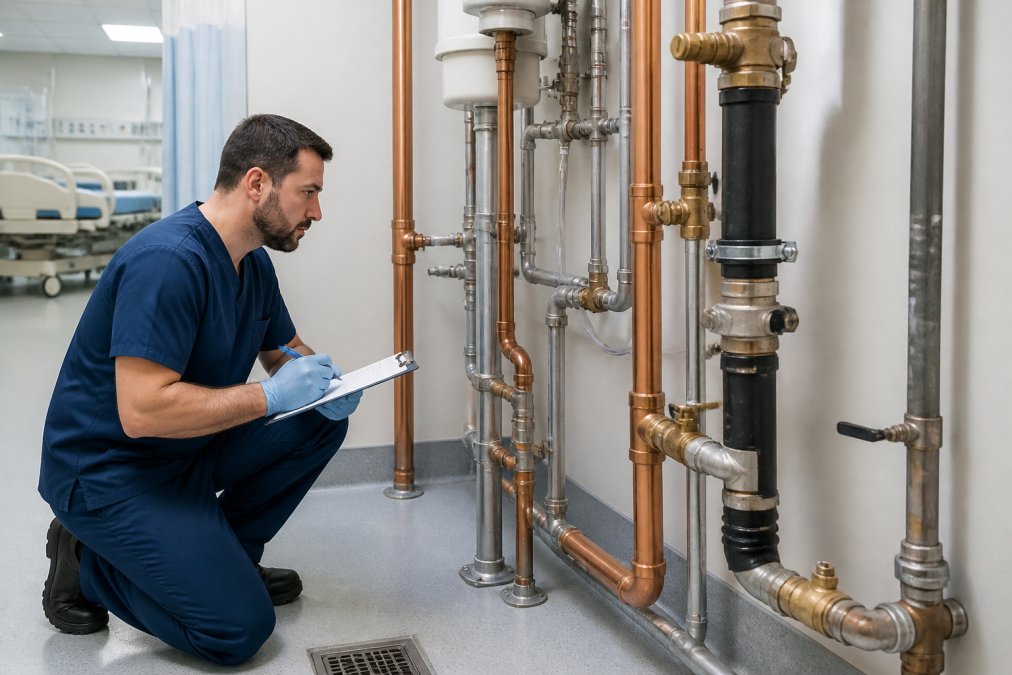
 ultimate-guide
Plumbing Compliance for Medical Facilities: A 2026 Guide
Table of Contents
- Why Plumbing Compliance Matters in Medical Facilities
- Regulatory Framework: National Plumbing Code and Medical Standards
- CSA B64 Backflow Prevention Standards for Healthcare
- Healthcare Facility Water Temperature Regulations and Safety
- Plumbing System Risk Assessment for Hospitals and Clinics
- Infection Control and Water Quality in Medical Plumbing
- Maintenance, Inspection, and Emergency Response Protocols
- Retrofitting Older Medical Facilities for Compliance
Last Updated: August 22, 2026
Why Plumbing Compliance Matters in Medical Facilities
Medical facilities operate under extraordinary pressure. A single plumbing failure can compromise patient safety, trigger infection outbreaks, or force operational shutdowns that cost thousands per hour. Plumbing compliance for medical facilities isn't optional, it's a regulatory requirement and a patient protection mechanism.
Medical facility plumbing manages sterile water for surgery, life support equipment cooling, infection control protocols, and emergency response systems. A burst pipe in a hospital can interrupt dialysis treatments, contaminate surgical suites, or disable fire suppression systems. Most compliance issues are preventable through proper design, maintenance, and monitoring.
Health Canada's guidance on healthcare facility infrastructure emphasizes that plumbing systems must meet multiple overlapping standards: national codes, provincial regulations, industry standards, and facility-specific risk assessments.
Regulatory Framework: National Plumbing Code and Medical Standards
Plumbing compliance for medical facilities starts with understanding which codes and standards apply. Canada's National Plumbing Code (NPC) forms the foundation, but healthcare facilities must also meet requirements from provincial health authorities and specialized standards for medical gas systems and infection control.
The National Plumbing Code establishes minimum standards for materials, sizing, testing, and safety protocols. For medical facilities, compliance means exceeding code minimums in critical areas. Provincial authorities often layer additional requirements on top of the NPC.
Beyond the NPC, medical facilities must reference CSA B64 (backflow prevention), CSA B128 (water quality), and guidelines from the Facility Guidelines Institute (FGI) for healthcare facility design. A plumbing system can pass code inspection and still fail to meet infection control requirements for medical facilities.
Code enforcement responsibility varies by province. Most provinces delegate enforcement to municipal authorities, but healthcare facilities often have additional oversight from provincial health ministries. Understanding which authority has jurisdiction over which aspects of your system prevents costly compliance gaps.
CSA B64 Backflow Prevention Standards for Healthcare
Backflow prevention is non-negotiable in medical facilities. When water pressure drops or reverses, contaminated water can flow backward into the clean water supply. In a hospital, this means surgical irrigation water could become contaminated, or potable water could mix with medical gas system fluids.
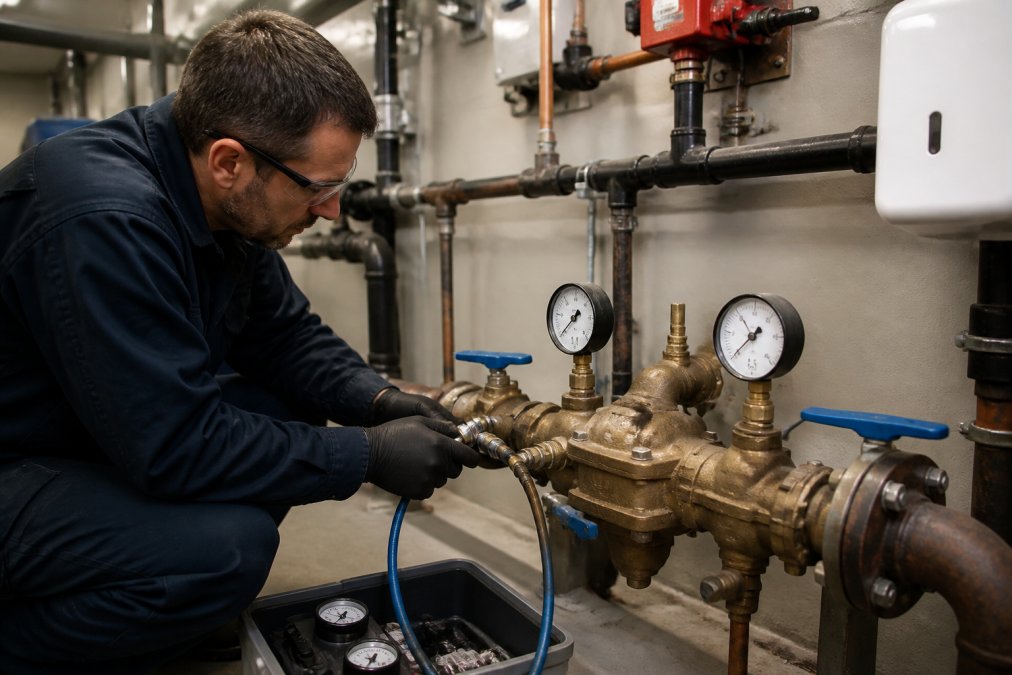
CSA B64 Backflow Prevention Standards for Healthcare requires multiple layers of protection depending on hazard level. Medical facilities typically fall into the high-hazard category because of life support equipment, sterile water systems, and pharmaceutical connections.
Backflow prevention devices must be installed at every point where medical gases, pharmaceutical solutions, or non-potable water could connect to the potable water supply. Each device must be tested annually and certified by a qualified technician. For high-hazard medical applications, reduced pressure principle (RP) devices or double check valve assemblies (DCVA) are typically mandated.
Testing protocols under CSA B64 are strict. Annual certification requires documenting device operation, relief valve function, and water flow rates. Testing must be performed by a certified backflow prevention technician, and records must be maintained for inspection.
Healthcare Facility Water Temperature Regulations and Safety
Water temperature control in medical facilities prevents scalding injuries and controls waterborne pathogens. Healthcare facility water temperature regulations establish minimum and maximum temperatures for different water uses.
Hot water systems must maintain temperatures hot enough to kill legionella bacteria (typically 60°C or higher at the source) but cool enough at user points to prevent scalding (typically below 50°C) (the CDC). This requires mixing valves, circulation pumps, and temperature monitoring at multiple points.
Legionella grows in warm water between 20°C and 45°C (peer-reviewed research). Water stored or circulated at temperatures below 20°C or above 60°C suppresses legionella growth. Medical facilities must design hot water systems that deliver hot water quickly (within 60 seconds at most outlets) to prevent stagnation and bacterial growth.
Thermostatic mixing valves (TMVs) are critical infrastructure. These devices automatically blend hot and cold water to maintain safe user temperatures while keeping the main supply hot enough for legionella control. Temperature monitoring systems, manual checks or automated sensors, are required at the source, circulation lines, and user points.
Stagnant water is a legionella risk. Medical facilities must design piping to minimize dead legs (sections where water doesn't circulate regularly). Any branch that doesn't receive regular flow must be flushed or eliminated.
Plumbing System Risk Assessment for Hospitals and Clinics
Every medical facility needs a documented risk assessment of its plumbing system. This is an ongoing process that identifies vulnerabilities, prioritizes repairs, and guides maintenance spending.
A comprehensive assessment starts with mapping every water source, treatment system, major pipe run, outlet, and connection point. Identify which systems serve critical functions (surgery, dialysis, life support) and which serve general purposes. Critical systems need redundancy; general systems need reliability.
Next, evaluate each system against applicable standards. Does the potable water supply meet CSA B128 quality standards? Are backflow prevention devices installed and certified? Do hot water systems maintain proper temperatures? Are emergency water supplies available if the main supply fails?
Risk assessment must consider aging infrastructure. Copper piping corrodes over decades. Soldered joints fail. Valves seize. A physical inspection helps estimate remaining system life and identify components likely to fail soon.
Rate risks by consequence and likelihood. A potential contamination of surgical suite water is high consequence. A slow leak in a non-critical branch is low consequence. This matrix helps prioritize spending on the most critical vulnerabilities.
Maintain records of all assessments, inspections, test results, and repairs. These records demonstrate systematic compliance and help regulatory inspectors understand your facility's approach to maintenance.
Infection Control and Water Quality in Medical Plumbing
Water quality in medical facilities goes far beyond municipal water treatment. Surgical irrigation water, dialysis water, and sterilization equipment water must meet specific microbiological and chemical standards.
CSA B128 establishes water quality standards for healthcare facilities, addressing microbiological contamination (bacteria, viruses, endotoxins), chemical contamination (chlorine, heavy metals), and physical contamination (particulates, turbidity). Different water uses require different quality levels.
Many medical facilities require point-of-use water treatment in addition to municipal treatment. This might include carbon filtration (to remove chlorine), micron filtration (to remove bacteria), ultraviolet treatment (to inactivate viruses), or reverse osmosis (for dialysis water). These systems require regular maintenance and filter replacement.
Biofilm formation is a persistent challenge. Biofilm is a layer of bacteria and organic material that adheres to pipe interiors. Legionella bacteria can hide inside biofilm and survive disinfection attempts. Preventing biofilm requires proper water temperature maintenance, regular flushing, and periodic chemical treatment.
Waterborne pathogens of concern include legionella (causes pneumonia), pseudomonas (opportunistic infection), and various viruses. Immunocompromised patients are especially vulnerable. Documentation of water quality testing is mandatory, with most facilities testing at least quarterly. If contamination is detected, the facility must have a documented response protocol.
Maintenance, Inspection, and Emergency Response Protocols
Reactive maintenance is unacceptable in medical facilities. Preventative maintenance systems ensure that plumbing components are inspected, tested, and replaced before failure occurs.

A preventative maintenance program should include scheduled inspections of all critical components: backflow prevention devices, thermostatic mixing valves, water heaters, circulation pumps, and treatment systems. Inspection frequency depends on component age and criticality.
Testing protocols must be documented and scheduled. Backflow prevention devices require annual certification. Water temperature must be monitored and recorded regularly. Water quality testing should be scheduled regularly. These are compliance requirements, not optional tasks.
Emergency response protocols are often overlooked until a crisis occurs. Medical facilities need documented procedures for contamination, pipe ruptures, and hot water system failures: who is notified, what systems are shut down, what alternatives are activated, and how patient care continues.
Staff training is critical. Maintenance staff need to understand the plumbing system well enough to identify problems and implement basic emergency procedures. Clinical staff need to know which water sources are safe during emergencies.
Retrofitting Older Medical Facilities for Compliance
Many older medical facilities have plumbing systems that predate modern compliance standards. Retrofitting is complex, expensive, and often disruptive, but necessary to ensure patient safety and meet regulatory requirements.
The first step is a detailed assessment of the existing system: materials, age, treatment systems, backflow prevention, and dead legs. This identifies which components can remain and which must be replaced.
Copper piping is generally acceptable and can last decades. Older galvanized steel piping often needs replacement because of corrosion. Water treatment systems in older facilities often need upgrading to meet current standards.
Temperature control retrofitting often requires significant work. If the existing hot water system can't maintain proper temperatures, thermostatic mixing valves must be installed at all outlets. If dead legs exist, piping must be reconfigured.
The challenge with retrofitting is maintaining operations while work is underway. Many facilities phase work, coordinate with operational schedules, and perform work during low-patient-volume periods.
Cost is a significant barrier. A comprehensive retrofit can cost hundreds of thousands of dollars. However, spreading work over several years makes it manageable. Prioritizing critical systems first, surgery, dialysis, life support, ensures the highest-risk areas are addressed first.
Medical facility plumbing compliance is a continuous practice. Regulations evolve, equipment ages, and new vulnerabilities emerge. Facilities that stay compliant treat plumbing as critical infrastructure, maintain detailed documentation, and work with qualified professionals to identify and address issues before they become problems.
If your facility is uncertain about compliance status, start with a professional assessment. UMark Plumbing and Drain Inc. can help you evaluate your system against current standards, identify gaps, and develop a plan to address them. Get a free quote to discuss your facility's specific needs and learn how we can help ensure your plumbing system supports safe patient care.
Frequently Asked Questions
Q: What are the CSA B64 standards for backflow prevention in healthcare?
A: CSA B64 establishes requirements for backflow prevention devices in medical facilities to protect potable water supplies from contamination. The standard mandates pressure integrity tests, regular inspections, and proper installation of backflow preventers at cross-connection points. Medical facilities must use certified devices and maintain documentation of all testing. Compliance protects both patients and staff from waterborne pathogens and ensures the facility meets regulatory requirements under the National Plumbing Code of Canada.
Q: How often should medical facility plumbing systems be inspected?
A: Medical facility plumbing systems should be inspected at minimum annually, with more frequent inspections for critical care areas and life support equipment connections. High-risk zones like surgical suites, dialysis units, and sterile processing areas may require more frequent assessments. Backflow prevention devices must be tested annually and certified by qualified technicians. Emergency response inspections should occur immediately after any system failure or water quality incident. Documentation of all inspections is mandatory for regulatory compliance.
Q: What plumbing requirements apply to infection control in hospitals?
A: Infection control plumbing requirements include legionella control measures, temperature regulation to prevent biofilm growth, proper sanitary drainage design, and cross-connection prevention. Hot water systems must maintain temperatures above 55°C to inhibit bacterial growth, while cold water should stay below 20°C. Fixture design must prevent water stagnation, and all drainage systems must meet code to eliminate pathogen pathways. Regular flushing protocols, water quality testing, and hazard analysis are essential components of infection prevention strategies in healthcare facilities.
Q: How do thermostatic mixing valves protect patients in medical facilities?
A: Thermostatic mixing valves (TMVs) regulate water temperature to prevent scalding while maintaining temperatures necessary for infection control. They blend hot and cold water to deliver consistent, safe temperatures to fixtures throughout the facility. TMVs are especially critical in areas serving vulnerable populations like pediatric and geriatric units. These valves must meet CSA standards and require regular maintenance and testing to ensure proper function. Failure of a TMV can create both safety hazards and infection control risks, making their inspection and replacement part of mandatory compliance protocols.
Q: What should a plumbing system risk assessment for hospitals include?
A: A comprehensive risk assessment examines water quality, pressure integrity, cross-connection hazards, temperature control systems, and emergency response capacity. It evaluates the condition of copper piping, brazed joints, and all connection points for potential contamination pathways. The assessment identifies critical equipment dependencies, backup systems, and failure scenarios. It includes hazard analysis of life support equipment connections and sanitary drainage adequacy. Results guide prioritization of upgrades, maintenance scheduling, and emergency protocols. Facility managers should conduct assessments periodically or after major renovations.
Q: Are your technicians certified to work on medical facility plumbing systems?
A: Yes. Our certified team at UMark Plumbing and Drain Inc. has over 20 years of experience serving medical facilities and understands the specialized requirements of healthcare plumbing systems. Our technicians are trained in regulatory compliance, backflow prevention testing, and infection control protocols. We maintain current certifications and stay updated on National Plumbing Code changes and FGI guidelines. Every technician who works on your medical facility plumbing is qualified to handle the critical safety and compliance standards your facility requires.
This article was written using GrandRanker