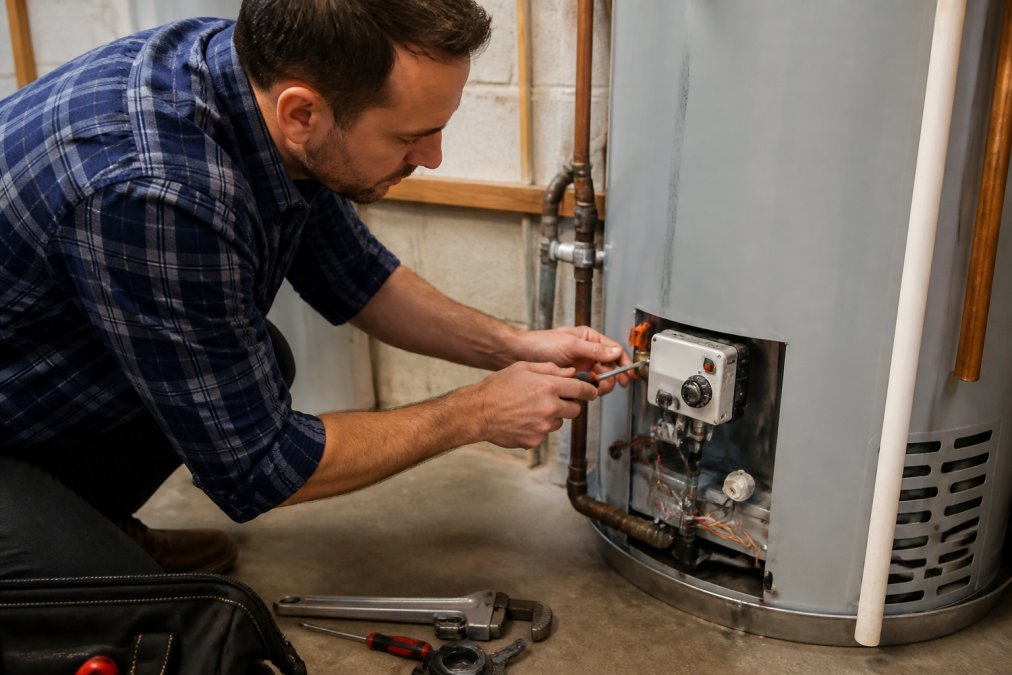
 listicle
Water Heater Repair Cost Estimate 2026: What to Expect
Table of Contents
- Water Heater Repair Cost Estimate 2026: Quick Comparison
- What Affects Your Water Heater Repair Cost Estimate
- Signs a Water Heater Needs Repair
- Water Heater Repair vs Replacement Cost: Which Makes Sense?
- Emergency Plumbing Repair Rates: What Changes After Hours
- Rebates, Incentives, and Disposal Costs Most Homeowners Miss
- Conclusion
- Frequently Asked Questions
Last Updated: September 14, 2026
Water Heater Repair Cost Estimate 2026: Quick Comparison
A water heater repair cost estimate in 2026 depends on the fault, the fuel type, and whether the job lands during business hours or at 2 a.m. At UMark Plumbing and Drain Inc., most homeowners aren't shocked by the repair itself, they're shocked by the extras: after-hours premiums, permit fees, and ordered-in parts. This guide breaks down what drives your invoice, and whether a repair is worth doing at all.
No legitimate plumber quotes a fixed price over the phone. What you can get is a firm diagnostic range and a clear explanation of what changes it.
Most guides list national averages as if labour rates, permit costs, and parts availability were the same everywhere. They aren't, the variables below matter more than any benchmark.
| Cost Factor | What It Covers | Why It Moves the Price |
|---|---|---|
| Unit type and fuel | Gas storage tank, electric, tankless on-demand | Parts availability and venting requirements differ |
| Age and condition | Sediment buildup, corrosion, failed components | Older units often need multiple parts at once |
| Labor | Diagnosis, access, installation time | Basement access and shut-off valve condition add time |
| Permit fees | Plumbing code compliance sign-off | Required for many replacements, not for minor repairs |
| Timing | Scheduled vs. emergency call-out | After-hours and weekend rates apply |
What Affects Your Water Heater Repair Cost Estimate
Three things decide the number: what broke, how hard it is to reach, and when you call. A thermocouple swap on an accessible unit is a short job; a failed pressure relief valve behind a finished wall is not.
Unit Type, Fuel Source, and Age
Gas storage tanks and electric water heaters share some components and almost nothing else. Gas units add a thermocouple, pilot assembly, and venting requirements; electric units lean on heating elements and circuit capacity. Tankless systems use their own parts, so a second visit is more likely.
Age compounds everything. A unit past its lifespan expectancy often needs an anode rod, expansion tank, or new pressure relief valve in the same visit, and once you're paying for three parts and two hours of labour, the repair-vs-replace math changes fast (Heating and cooling with a heat pump).
Labor, Parts, and Permit Fees
Installation labor is usually the largest line on a repair invoice, and it scales with access. A unit in an open utility room is straightforward; one behind a finished ceiling with a corroded shut-off valve is a different job entirely.
Permit fees apply to many replacements under plumbing code compliance rules and are set locally; minor repairs typically don't trigger one. If a contractor says a permit isn't needed for a full replacement, ask them to confirm that in writing.
Signs a Water Heater Needs Repair
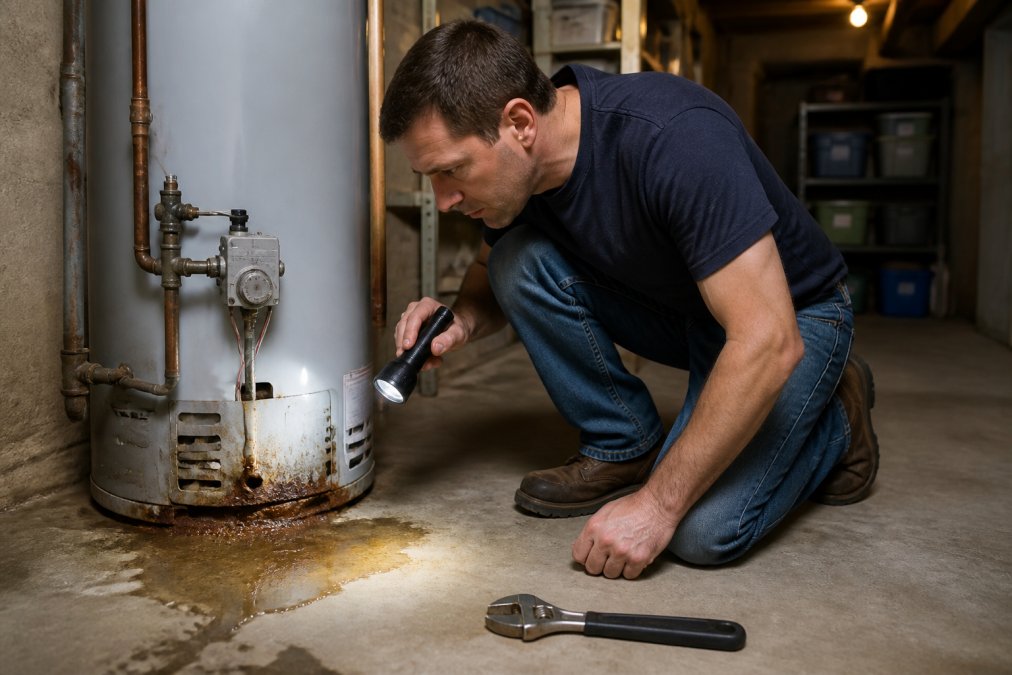
The clearest signs a water heater needs repair are rust-colored water, moisture around the base, rumbling during heating, and inconsistent hot water. Any one justifies a diagnostic visit before it escalates into a flood.
Watch for these specific indicators:
- Sediment buildup produces a rumbling or popping sound as water heats beneath the layer of mineral deposits.
- Leak detection at the base or from the tank itself usually means the inner shell has failed, which is not a repairable condition.
- Inconsistent temperature points to a failing heating element on electric units or a thermocouple issue on gas units.
- Discolored hot water often signals a corroded anode rod that has stopped protecting the tank lining.
- Water pressure regulation problems elsewhere in the house can sometimes trace back to the water heater's expansion tank.
One distinction matters most: a leak from a fitting, valve, or drain pan is usually fixable, but a leak from the tank body itself is not. No reputable technician welds a residential tank.
Water Heater Repair vs Replacement Cost: Which Makes Sense?
The repair-versus-replacement decision comes down to the ratio of repair cost to replacement cost, adjusted for remaining lifespan. If a repair costs a large share of a new unit and the tank is near the end of its service life, replacement is usually the better financial call.
The 50% Rule and Other Decision Frameworks
The 50% rule is the simplest framework: if the repair quote exceeds roughly half the cost of a new installed unit, replace instead. It's a useful starting filter, but it ignores age. A better version weighs both.
Use this decision matrix:
| Situation | Recommended Action | Reasoning |
|---|---|---|
| Unit under 8 years old, single failed part | Repair | Plenty of service life remaining |
| Unit over 10 years old, one failed part | Repair, but plan for replacement | You're buying time, not solving the problem |
| Unit over 10 years old, two or more failed parts | Replace | Cumulative cost approaches replacement |
| Tank body leaking | Replace immediately | Not a repairable condition |
| Repair quote above half of replacement cost | Replace | Poor cost-benefit ratio |
Emergency Plumbing Repair Rates: What Changes After Hours
Emergency plumbing repair rates run higher than scheduled work because of after-hours labor premiums, minimum call-out charges, and closed parts suppliers. Expect a higher service call fee and per-hour rate, but most guides won't tell you how that premium is built, or when paying it is the wrong call.
How the After-Hours Premium Is Actually Calculated
A scheduled service call bundles a diagnostic or trip fee, labor at a standard hourly rate, and parts at a modest markup. After hours, each can move independently:
- Trip fee often doubles or more, because the technician is being pulled from on-call rather than a routed day schedule.
- Labor rate typically carries a multiplier, commonly in the range of 1.5x to 2x the standard rate on evenings and weekends, and higher on statutory holidays.
- Minimum billing usually applies. You may be charged for a minimum block of time (often one to two hours) regardless of how long the job actually takes.
- Parts markup increases when a technician has to source a component from an emergency supplier or return the next day with the part.
- Diagnosis-only visits are billed even if you decline the repair, and that fee is rarely refundable.
The legitimate reason for the premium is simple: keeping certified technicians available overnight and on weekends costs money. The illegitimate version is a company that advertises round-the-clock availability then can't reach you for hours. When you call, ask two questions: what's the current wait time, and is the after-hours rate confirmed before dispatch.
When to Pay the Premium, and When to Wait
Not every failure is a genuine emergency. Use this framework before you dial:
| Situation | Call Now or Wait? | Why |
|---|---|---|
| Active leak from the tank body or a fitting | Call now | Water damage compounds hourly; shut off the supply and gas/electric first |
| No hot water, unit under 10 years old | Wait until morning | Almost always a component failure, not a safety event |
| No hot water, unit over 10 years old | Wait, but plan for replacement | The repair may not be worth the emergency premium |
| Gas smell or scorching at the unit | Call now, and evacuate if strong | Potential safety hazard, treat as urgent regardless of hour |
| Rumbling, popping, or discolored water | Wait | Sediment or anode issues are not time-critical |
| Pilot or ignition failure on gas | Wait unless it's winter and heat is affected | Usually a thermocouple or igniter, not dangerous |
A useful rule of thumb: if the failure risks property damage or safety, pay the premium. If it only risks inconvenience, the same repair at 9 a.m. on a weekday is often cheaper for identical work.
The single most useful thing you can do before an emergency is find out whether your chosen plumber charges a flat after-hours rate or an open-ended hourly one. Flat rates protect you; open-ended hourly rates reward slow work. Confirm the rate and the minimum billing block before dispatch, not when the invoice arrives.
If you shut off the water supply to stop a leak, also shut off the gas valve or the breaker feeding an electric unit. Repairing or diagnosing a water heater while it still has an active fuel or power source is a genuine safety risk, and it's the most common mistake homeowners make during a late-night call.
Rebates, Incentives, and Disposal Costs Most Homeowners Miss
Two costs get left out of most repair-versus-replace calculations: disposal of the old unit and efficiency incentives on the new one. Both change the real math, and this is where the difference between a "cheap" quote and a genuinely cheaper job shows up.
Disposal and Recycling: The Hidden Line Item
A water heater is a large, heavy appliance with a steel tank and, in gas models, components needing proper handling. Many municipalities don't accept them in curbside pickup, so removal and recycling is a line item on the replacement quote. That typically involves:
- Draining and disconnecting the old unit before it can be moved, a step that adds labor time, especially if the shut-off valve is seized.
- Removal from the home, which for a basement or tight utility closet can require two people and a stair carry.
- Recycling the steel tank through a scrap metal facility or municipal depot, which may or may not charge a fee depending on the jurisdiction.
- Handling gas components, a gas unit must be properly disconnected and the line capped by a licensed technician, not simply hauled away.
Ask whether removal and disposal are included before comparing quotes. A "cheaper" quote that excludes disposal often isn't cheaper once you add hauling the old tank yourself. Some contractors include removal; others bill it separately, neither is wrong, but you need to know which you're looking at.
How Efficiency Incentives Actually Work
On the other side of the ledger, energy efficiency rating matters at purchase time. Higher-efficiency units can qualify for utility and government programs, and eligibility rules and amounts change by province and program year, so check current program terms directly rather than rely on a number from last year.
Incentives generally fall into three buckets:
- Utility rebates, offered by your local electricity or gas provider, often tied to a minimum efficiency rating (for example, a specific energy factor or uniform energy factor threshold). These are usually applied as a bill credit or a mailed cheque after installation.
- Government efficiency programs, federal and provincial programs that fund upgrades to higher-efficiency equipment. These tend to have application windows, pre-approval requirements, and documentation rules, so timing matters.
- Tax credits, some efficiency upgrades qualify for a credit claimed at tax time, which reduces the net cost but only after you file.
Your utility's own site and the Natural Resources Canada energy efficiency resources are the places to confirm what's currently available before you commit to a unit. The key discipline is to check before you buy, not after, most programs require the unit to meet a specific rating and the installation to be documented in a particular way.
Calculating Your True Net Cost
The number that matters isn't the sticker price of the new unit. It's:
Installed price − rebate − tax credit + disposal (if not included) = net cost
Run that calculation for both a standard-efficiency and a high-efficiency unit. The high-efficiency unit often costs more upfront, but the rebate plus lower operating cost over its lifespan can close or reverse the gap, a comparison most homeowners never make, because the rebate and disposal figures aren't in front of them at quote time.
If you're replacing rather than repairing, ask your contractor whether they handle rebate paperwork. Some do, some don't, and the difference is often a few hours of your own time chasing forms after the install is already done. Also ask for the model's efficiency rating in writing, you'll need it for most applications.
For homeowners weighing whether to repair at all, Canada Mortgage and Housing Corporation guidance on home maintenance treats water heating systems as a scheduled maintenance item, which is a useful framing. A unit on a maintenance schedule fails less often and fails more predictably, and predictable failure is what lets you plan a replacement around a rebate window instead of paying an emergency premium.
Conclusion
The hard part of a water heater repair cost estimate isn't finding a number, it's finding one you can trust before the work starts, from someone who shows up when they say they will. That's the gap UMark Plumbing and Drain Inc. exists to close. With over 20 years of experience, a certified team, and 24/7 emergency services, we diagnose the fault, explain what's driving the cost, and give you a clear quote before we start. Whether it's a failed thermocouple at midnight or a full replacement you've been putting off, get a free quote from UMark Plumbing and Drain Inc. and know the number before the wrench comes out.
Frequently Asked Questions
How much should I expect to pay to repair a water heater in 2026?
A water heater repair cost estimate in 2026 depends on the part, the unit type, and whether it is an emergency call. Request an itemized quote in writing before work starts so the final invoice matches the estimate.
What are the common signs a water heater needs repair?
Watch for lukewarm water, rumbling or popping sounds from sediment buildup, rust-colored water, visible leaks around the base or fittings, and the pilot light repeatedly going out. A pressure relief valve that drips or a unit that cannot keep up with demand also point to trouble. Catching these early usually keeps the repair simple and affordable. If you notice any of them, book a diagnostic before the issue escalates into a full replacement.
Is it more cost-effective to repair or replace a water heater?
Compare the repair quote against the age and remaining lifespan of the unit. A tank water heater typically lasts 8 to 12 years, so a $700 repair on a 12-year-old tank rarely pays off. A common rule: if the repair costs more than half of a new installed unit, or the tank is past 10 years old, replacement is usually the better financial call. Get both numbers in writing before deciding.
Does the age of my water heater impact repair costs?
Yes. Older units often need discontinued parts, which cost more and take longer to source. Sediment buildup inside an aging tank also makes labor more involved because technicians may need to drain and flush the system first. A unit past its lifespan expectancy is also more likely to need a second repair within a year, so an aging water heater can turn a single service call into a recurring expense. Factor age into any repair-versus-replace decision.
How much do emergency plumbing repair rates add to a standard service call?
Emergency plumbing repair rates typically include an after-hours surcharge on top of the standard service call fee. Weekend, holiday, and overnight calls cost more because the technician is dispatched outside normal hours. The exact premium varies by provider and job complexity, so ask for the after-hours rate upfront before agreeing to the visit. Scheduling a repair during regular hours, when the issue allows it, is almost always cheaper.