 how-to
How to Choose the Right Water Heater Size (2026 Guide)
Table of Contents
- Why Water Heater Size Matters More Than You Think
- Step 1: Calculate Your Peak Hour Demand
- Understanding the First-Hour Rating Calculation
- Tank vs Tankless Water Heater Sizing: Key Differences
- How Many Gallons Do You Really Need? A Sizing Chart
- Signs Your Water Heater Is Too Small for Your Home
- Climate, Retrofits, and Other Factors to Consider
- Get a Professional Sizing Assessment
- Frequently Asked Questions
Last Updated: September 9, 2026
Why Water Heater Size Matters More Than You Think
Choosing the right water heater size directly impacts your energy bills, comfort, and the lifespan of the appliance. An undersized unit leaves you shivering mid-shampoo, while an oversized tank wastes energy heating water you never use.
At UMark Plumbing and Drain Inc., our team has spent over 20 years helping homeowners across North York and Vaughan diagnose their hot water needs. This guide breaks down the sizing process into clear, manageable steps.
The core of proper sizing is matching the unit's capacity to your household's peak demand. Below, we walk you through how to determine your needs, starting with the most critical metric: your peak hour demand.
Step 1: Calculate Your Peak Hour Demand
Peak hour demand is the maximum amount of hot water your household uses in a single hour, typically during the morning rush. Measured in litres, it is the single most important factor in your water heater size calculation.
Start by listing the activities that happen simultaneously during your peak time. A standard shower uses about 38 litres of hot water, a washing machine 38 to 76 litres per load, and a dishwasher 23 to 38 litres (energy.gov).
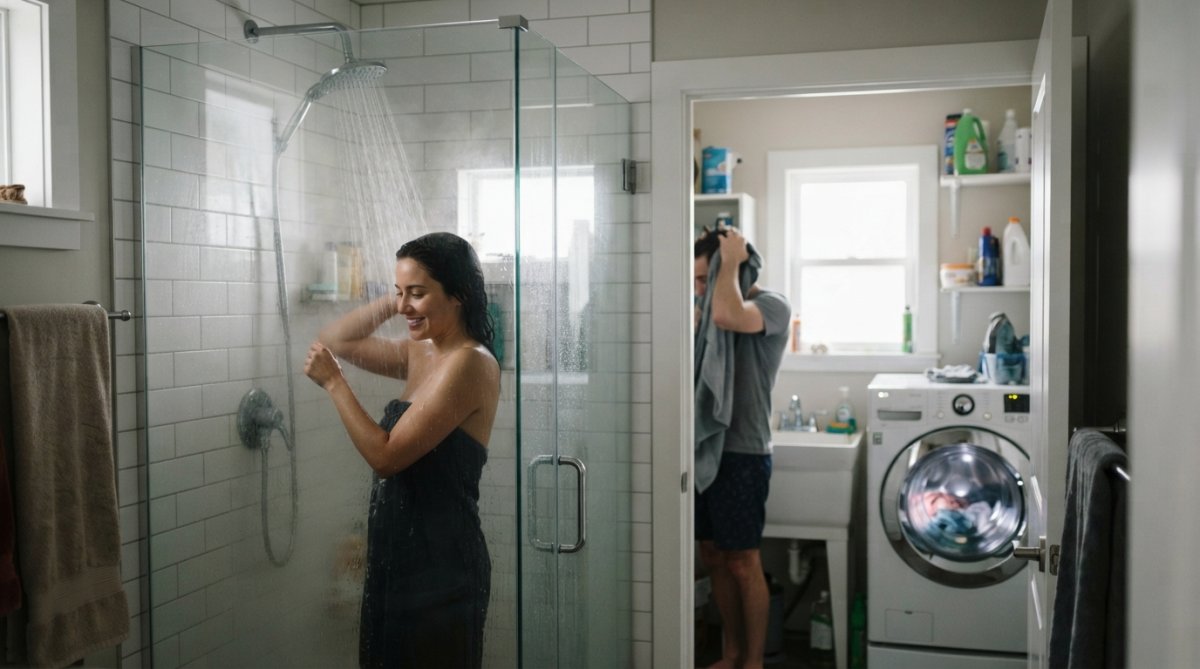
Add up the total litres used during that single hour. If two showers run (76 litres total) and the washing machine runs (57 litres), your peak hour demand is 133 litres. Most conventional 150-litre tanks have a first-hour rating that can meet this demand, but you must verify that rating.
Why the Standard Worksheet Is Incomplete
The classic worksheet assumes standard fixtures, but modern Canadian homes increasingly feature fixtures that change the math. A rainfall showerhead can flow at 9.5 litres per minute (LPM) or more, compared to 7.6 LPM for a standard head. A deep soaking tub can demand 114 to 151 litres just to fill, so your demand calculation must account for that entire volume in a single hour.
Consider a family of four where one person fills a soaking tub (133 litres) while another takes a 10-minute shower with a rainfall head (95 litres). The peak hour demand is now 228 litres, nearly double the baseline estimate.
The Climate Variable: Groundwater Temperature
Another factor most online guides ignore is the temperature of the incoming groundwater. In southern Ontario, groundwater can hover around 9°C (48°F) in the winter, while in the Prairie provinces or northern territories, it can drop to 4°C (39°F) or lower. Colder incoming water requires a larger temperature rise to reach your desired 49°C (120°F) set point.
This temperature rise directly affects the recovery rate you need. A gas water heater with a 40,000 BTU/hour burner recovers faster than a 30,000 BTU/hour model, but even a high-BTU unit will struggle if undersized. For tankless units, the LPM rating is quoted at a specific temperature rise, often 35°C (63°F). A unit rated for 24.6 LPM at a 35°C rise might only deliver 17 LPM at a 44°C rise.
A Practical Worksheet for Canadian Homes
To get an accurate number, build a table for your busiest hour. List every fixture in use, its flow rate or fill volume, and the duration of use:
| Fixture | Flow Rate (LPM) | Duration (minutes) | Hot Water Used (litres) |
|---|---|---|---|
| Shower (standard head) | 7.6 | 10 | 76 |
| Shower (rainfall head) | 9.5 | 10 | 95 |
| Bathroom faucet | 5.7 | 5 | 28.5 |
| Kitchen faucet | 5.7 | 5 | 28.5 |
| Washing machine (efficient) | , | , | 38-57 per load |
| Dishwasher | , | , | 23-38 per cycle |
| Soaking tub fill | , | , | 114-151 per fill |
Add up the total for the single hour when the most fixtures run simultaneously. If you have a soaking tub, count its full fill volume. The sum is your true peak hour demand.
Understanding the First-Hour Rating Calculation
The first-hour rating (FHR) is how much hot water a tank can deliver in one hour, starting with a full tank. It is more accurate than storage capacity alone because it accounts for the burner or element heating new water as the tank empties.
A common mistake is assuming a 150-litre tank provides 150 litres of hot water. A typical 150-litre gas water heater might have an FHR of 174 to 189 litres, while an electric model might only have an FHR of 136 to 151 litres. Gas burners heat water much faster than electric elements.
The rule is simple: your water heater's first-hour rating must be equal to or greater than your household's peak hour demand. If your peak demand is 190 litres but your electric tank's FHR is only 144 litres, you will run out of hot water. According to the U.S. Department of Energy's water heating guidance, matching the FHR to your usage patterns is the most reliable way to avoid undersizing and ensure adequate supply.
Tank vs Tankless Water Heater Sizing: Key Differences
The sizing logic shifts completely when you compare a storage tank to a tankless water heater. A tankless system does not store hot water; it heats it on demand. Its sizing is based on the flow rate, measured in litres per minute (LPM), required by your fixtures simultaneously.
For a tankless unit, calculate the total flow rate of every hot water fixture you might use at once. A typical shower has a flow rate of 9.5 LPM, and a faucet might use 5.7 LPM. If you are running two showers and a faucet, you need a unit that can deliver at least 24.6 LPM.
This is where tank vs tankless water heater sizing becomes critical. A tankless unit that is too small will struggle to raise the water temperature in the winter, resulting in lukewarm showers. A unit that is too large will waste energy cycling on and off.
How Many Gallons Do You Really Need? A Sizing Chart
To simplify the decision, most manufacturers and plumbers use a general sizing chart based on household occupancy and the number of bathrooms. This chart provides a quick baseline for conventional tank water heaters, but you should always verify the recommendation against your specific peak hour demand calculation.
| Household Size | Number of Bathrooms | Recommended Tank Size | Typical First-Hour Rating Needed |
|---|---|---|---|
| 1-2 People | 1-2 | 114-151 Litres | 151-190 Litres |
| 2-4 People | 2-3 | 151-190 Litres | 190-228 Litres |
| 5+ People | 3+ | 190-303 Litres | 228-303+ Litres |
This chart serves as a starting point, but your actual needs may differ based on your habits. A family of four with a large soaking tub will need a larger unit than a family of four who only takes quick showers.
Signs Your Water Heater Is Too Small for Your Home
Identifying the signs your water heater is too small is often easier than doing the math. The most obvious indicator is running out of hot water during daily routines, such as the morning shower rush.
Other symptoms are less obvious but equally telling. If your water heater runs constantly to keep up with demand, your energy bills may be higher than expected. You might also notice that your showers are never as hot as you would like.
Frequent breakdowns are another clear sign of an undersized system. A unit that is constantly working to recover will wear out faster, leading to premature failure.
Climate, Retrofits, and Other Factors to Consider
Beyond household size, your local climate plays a significant role in the water heater size calculation. In colder regions, the groundwater temperature is much lower, sometimes around 5°C (41°F) in the winter, so your water heater must work harder to raise the incoming water to your desired 49°C (120°F).
The Retrofit Reality: What Fits in Your Home
Most sizing guides assume you are building new or have unlimited space. In reality, most Canadian homeowners are replacing an existing unit, and the physical constraints of the home often dictate what is possible. Before you commit to a larger tank or a tankless conversion, verify three things: the venting, the gas line, and the electrical panel.
Venting. A standard atmospheric gas water heater uses a metal vent that relies on natural draft. A power-vented model uses a fan and can be vented through a side wall with PVC pipe. If you are switching from a tank to a tankless unit, the venting almost certainly will change. Tankless units require dedicated, sealed combustion venting, typically 2-inch or 3-inch PVC, that must be routed to the outside. An older home with a masonry chimney may not be compatible with a tankless unit at all.
Gas line capacity. A standard 150-litre tank has a burner rated at roughly 36,000 to 40,000 BTU/hour. A tankless unit can demand 150,000 to 200,000 BTU/hour, four to five times more. A 1/2-inch gas line may be sufficient for a tank, but a tankless unit often requires a 3/4-inch or even 1-inch line running from the meter. Upgrading the gas line can range from a few hundred to over a thousand dollars.
Electrical panel. Tankless electric units are notorious for their electrical demands. A single whole-home electric tankless unit can require 120 to 150 amps of dedicated service. Most Canadian homes have a 100-amp or 200-amp panel. If you have a 100-amp panel and are considering an electric tankless unit, you will almost certainly need a panel upgrade to 200 amps, a significant expense.
The Temperature Rise Calculation in Practice
To understand how climate affects your choice, calculate the temperature rise for your specific location. Subtract the average winter groundwater temperature from your desired set point. For example, a home in Calgary with 4°C groundwater and a 49°C set point has a 45°C temperature rise. A home in Vancouver with 8°C groundwater has only a 41°C rise. The Calgary home needs a unit with a faster recovery rate or a higher BTU input.
For tankless units, this is even more critical. Manufacturers rate their units at a specific temperature rise, often 35°C. If your required rise is 45°C, the unit's LPM output drops by roughly 20-25%. A unit rated at 8 LPM at a 35°C rise might only deliver 6 LPM at a 45°C rise.
Space and Clearance Constraints
Finally, consider the physical footprint. A 228-litre tank is taller and wider than a 150-litre model. Measure your existing space, including clearance for the vent, the gas line, and the drain pan. In a tight closet, a tankless conversion might not be feasible without structural changes.
The Natural Resources Canada guidance on water heaters emphasizes that choosing an energy-efficient model is key, as the annual operating cost difference between standard and high-efficiency units can be substantial over the unit's lifespan. However, efficiency is meaningless if the unit cannot physically fit or be connected in your home. The retrofit assessment is the first step, and it often determines which sizing path is even available to you.
Get a Professional Sizing Assessment
While the calculations and charts above provide a solid framework, a professional assessment is the surest way to get the right unit the first time. A licensed plumber can perform a precise audit of your fixtures, measure your actual flow rates, and verify your home's gas line capacity or electrical panel.
Attempting to size and install a water heater without professional help can lead to code violations and safety hazards. Incorrect venting or gas connections are serious risks, and a faulty installation can void the manufacturer's warranty.
Our team at UMark Plumbing and Drain Inc. provides expert guidance and installation services across North York and Vaughan. With over 20 years of experience, our certified technicians handle everything from a simple tank replacement to complex tankless conversions, ensuring your new system is perfectly matched to your home.
Choosing the right water heater size involves balancing your household's peak demand against the unit's recovery capabilities, all while factoring in your local climate and home's infrastructure. For a precise, stress-free replacement, let the certified team at UMark Plumbing and Drain Inc. handle the assessment and installation with our 24/7 availability and affordable pricing. Get a free quote today.
Frequently Asked Questions
Is a 40-gallon water heater enough for a family of four?
For a family of four, a 150-litre tank is often the minimum, but it depends on your peak hour demand. If two people shower at the same time while the dishwasher runs, you will likely need a 190-litre unit. Calculate your household's simultaneous usage and compare it to the unit's first-hour rating. If you frequently run out of hot water, your current tank is probably too small.
How do I calculate the first-hour rating for my home?
First, list all hot water uses during your busiest hour of the day, such as showers, laundry, and dishwashing. Add up the total litres used in that hour. This is your peak hour demand. Then, look for a water heater whose first-hour rating (FHR) meets or exceeds that number. The FHR is listed on the unit's Energy Guide label.
What is the difference between tank and tankless water heater sizing?
Tank water heaters are sized by storage tank capacity in litres and their first-hour rating. Tankless units are sized by flow rate, measured in litres per minute (LPM), which is the amount of hot water they can produce on demand. For a tankless model, you must calculate your home's total simultaneous flow rate from fixtures like showers and taps, not just the tank volume.
Does the number of bathrooms affect water heater size requirements?
Yes, the number of bathrooms is a strong indicator of potential simultaneous usage. A home with three or more bathrooms likely has multiple showers running at once, increasing your peak hour demand. However, the exact number of people in your household matters more than the bathroom count. A large home with only two occupants has a lower demand than a small home with six.