 how-to
How to Verify Local Plumber Certification in 2026
Table of Contents
- Why Verifying Plumber Certification Matters Before You Hire
- Step 1: Understand the Difference Between Licensed and Insured
- Step 2: How to Check a Plumber's Trade Qualification Online
- Step 3: Ask for Proof of Certification and ID Badges On Site
- Step 4: How to Check if a Contractor Is Insured Properly
- Verifying Certification for Emergency vs. Scheduled Work
- Your Hiring a Certified Plumber Checklist
- What to Do If a Plumber Refuses to Show Credentials
- Frequently Asked Questions
Last Updated: September 5, 2026
Why Verifying Plumber Certification Matters Before You Hire
Plumber certification is the formal proof that a tradesperson has completed the required training, hours of supervised work, and examinations to perform regulated plumbing work safely and legally. Hiring an unlicensed contractor for a simple repair can turn into a costly liability when faulty work causes water damage, code violations, or safety hazards that your insurance may not cover. The UMark Plumbing and Drain Inc. team has spent over 20 years in the field.
Most homeowners only think to check credentials after a problem surfaces, which is backwards. A few minutes of verification before you book can prevent weeks of headaches later. This guide walks you through exactly how to verify local plumber certification so you can hire with confidence.
Step 1: Understand the Difference Between Licensed and Insured
A licensed contractor holds a trade qualification proving they are competent to perform regulated work, while being insured means they carry liability coverage that protects you if something goes wrong. These are two separate things, and you should confirm both before any work begins. Many homeowners assume a licensed plumber is automatically insured, but that is not always the case.
Trade certification is issued by the provincial regulatory body governing the trade. In many regions, a "journeyman" has completed their apprenticeship and earned full certification, while an "apprentice" is still under supervised training. An apprentice may be skilled but must work under a certified journeyman to perform regulated work legally.
The common mistake is treating an insured contractor as automatically certified. A handyman can carry general liability insurance without holding any plumbing trade qualification at all. That insurance protects them, not you, when their unlicensed work fails inspection.
Step 2: How to Check a Plumber's Trade Qualification Online
The fastest way to verify a plumber's credentials is to search the public register maintained by the trade authority that licenses plumbers in your province. These registers are searchable by name, business name, or registration number, and they confirm whether a tradesperson holds an active, valid certification.
Start by identifying the regulatory body for your region. The terminology varies, so a "trade license" in one province may be called a "certificate of qualification" or "trade certification" elsewhere. Provincial government websites typically list the correct authority and provide a link to their verification portal. According to the Canadian Council of Directors of Apprenticeship, each province manages its own apprenticeship and certification system, so you must search the register for the jurisdiction where the work will take place.
Here is how the system works in practice across the major provinces:
- In Ontario, the Skilled Trades Ontario (STO) register is the authoritative source. You can search by name or certificate number at skilledtradesontario.ca. The certificate will show the trade (e.g., Plumber 306A) and its status (e.g., "Active"). A journeyman plumber in Ontario holds a Certificate of Qualification (C of Q) with a 306A endorsement (skilledtradesontario.ca).
- In British Columbia, Technical Safety BC and SkilledTradesBC manage different aspects. For plumbers, SkilledTradesBC issues trade credentials, and you can verify a tradesperson's status through their online portal. The relevant trade is "Plumber" (trade code 423A).
- In Alberta, the Alberta Apprenticeship and Industry Training (AIT) system issues trade certificates. You can verify a certificate online through the Tradesecrets portal. The trade is listed as "Plumber" and the certificate will show a status of "Active" or "Suspended."
- In Quebec, the Commission de la construction du Québec (CCQ) regulates the industry, but for residential work, you may need to check with the Régie du bâtiment du Québec (RBQ). The RBQ issues contractor licenses, and you can verify a license number online, which is mandatory for any contractor performing work over a certain value.
A common pattern across all provinces is that the register will show not just the current status but also any conditions or suspensions. For example, a certificate may be listed as "Active" but with a note restricting the individual to certain types of work. Always read the full entry, not just the headline status.
You should also confirm that the business itself holds any required contractor licenses. Some municipalities require contractors to register locally in addition to holding individual trade certifications. A quick check of your city's licensing department can reveal whether the company has active registration and a clean compliance record. For example, the City of Toronto requires "Business Licensing" for certain trades, and the City of Vancouver has its own licensing system for contractors.
A practical shortcut: if you are searching for a company rather than an individual, ask for the company's master business license number and the individual technician's certificate number. Cross-reference both. A company may be licensed, but the specific person they send to your home may not be certified for the work they are about to perform.
Step 3: Ask for Proof of Certification and ID Badges On Site
A certified plumber should have no hesitation showing you their physical ID badge or certification card when they arrive at your door. Professional tradespeople carry proof of their qualifications because they understand why credential verification matters to their clients.
When the technician arrives, ask to see their photo ID and trade certification before they open a single tool. Compare the name on the card with the name on your booking confirmation. If the company sent an apprentice instead of the certified journeyman you spoke with on the phone, that is a legitimate reason to pause the job until you confirm who will be performing the work.
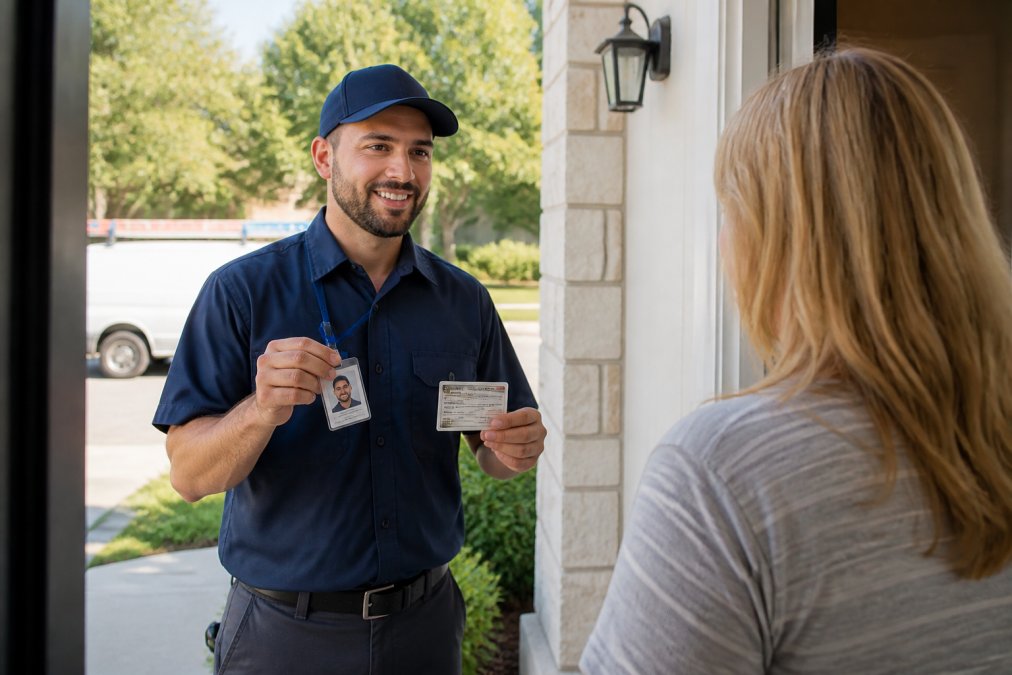
Legitimate companies expect this request and will not be offended by it. In fact, a reputable contractor welcomes the opportunity to demonstrate their professional standards. The request protects both of you and sets a tone of mutual respect for the job ahead.
Step 4: How to Check if a Contractor Is Insured Properly
To check if a contractor is insured, request a certificate of insurance directly from the company and verify it with the insurer before work begins. A verbal assurance of coverage is not sufficient, because you have no way to confirm the policy is active or that it covers the type of work being performed.
A proper certificate of insurance should name the contractor as the insured party, list the policy effective dates, and specify the coverage limits. You are looking for commercial general liability coverage, and if the job involves significant work, professional indemnity coverage is also worth confirming. The certificate should be issued by the insurance provider, not typed up by the contractor.
The background check does not end with reading the document. Call the insurance company listed on the certificate and confirm the policy is currently active. Policies lapse, and a contractor who let their coverage expire may not even realize it until they try to file a claim.
Verifying Certification for Emergency vs. Scheduled Work
Emergency plumbing situations create pressure to skip verification steps, but a burst pipe or severe leak does not change the legal requirements for who can perform regulated work. When water is pouring through your ceiling, the instinct is to hire the first person who answers the phone, and that is exactly when unlicensed operators make their money.
For scheduled work like a bathroom renovation or fixture installation, you have time to complete a full verification process days before the job starts. For emergencies, you should still verify the company's credentials before dispatching anyone to your home. A reputable business will have their licensing information readily available on their website, and their dispatcher should be able to confirm the certification status of the technician they are sending.
The real difference comes down to how you handle the verification. With an emergency, you may not have time to call the insurance company and wait on hold. You can, however, confirm the company holds active trade licenses and that their technicians are certified before you agree to the work. At UMark Plumbing and Drain Inc., our certified team is available 24/7, and we understand that homeowners need quick answers without sacrificing safety standards.
Your Hiring a Certified Plumber Checklist
Use this checklist before you commit to any plumbing contractor. It consolidates every verification step into a single workflow you can complete in minutes.
| Verification Step | What to Check | Why It Matters |
|---|---|---|
| Search public register | Active trade certification in your province | Confirms legal right to perform regulated work |
| Confirm business license | Municipal contractor registration | Ensures compliance with local hiring requirements |
| Request certificate of insurance | Active policy, correct coverage limits | Protects you from liability for damage or injuries |
| Verify ID on site | Photo matches booking, valid certification card | Confirms the certified person is actually doing the work |
| Check registration number | Matches name on contract and invoice | Creates accountability for the work performed |
Keep a copy of every document you verify. Screenshot the public register search results, save the certificate of insurance, and note the technician's certification number on the work order. This documentation protects you if any dispute arises about the quality or legality of the work.
What to Do If a Plumber Refuses to Show Credentials
If a plumber refuses to show their certification or ID badge, you have the right to stop the work immediately. Refusal to provide proof of qualification is a clear signal that the person may not hold valid credentials, and proceeding with the job puts you at risk of substandard work, code violations, and voided insurance coverage.
Politely but firmly explain that you require proof of certification before any work proceeds. A legitimate contractor will understand and comply. If they continue to refuse, ask them to leave. Do not pay for any work performed up to that point if it was not completed to a standard you can verify.
Once the contractor has left, your next step is to report the incident. Filing a report is the single most effective way to protect other homeowners and push unlicensed operators out of the market. Here is how to do it:
- Identify the right authority. For trade certification issues, report to the provincial apprenticeship authority (e.g., Skilled Trades Ontario, SkilledTradesBC, Alberta Tradesecrets). For contractor licensing or municipal bylaw violations, report to your city's licensing and standards department. For safety hazards or code violations resulting from the work, contact your local building inspection department.
- Gather your evidence. Before you call, write down the company name, the technician's full name if you have it, the vehicle license plate number, the date and time of the visit, and a description of what happened. If you took photos of the person or their vehicle, include those. If you have a written quote or estimate, keep a copy.
- File the complaint. Most provincial authorities have an online complaint form. For example, Skilled Trades Ontario has a dedicated "File a Complaint" portal. Your report should be factual and chronological. Avoid emotional language; stick to what was said, what was shown (or not shown), and what work was proposed.
- Follow up. Regulatory bodies are often understaffed, so your complaint may take weeks to process. You can follow up by phone or email to check on the status. Your report becomes part of the public record and can trigger an an inspection or investigation.
Many homeowners hesitate to report because they feel the process is cumbersome or they doubt it will make a difference. In practice, regulatory bodies do act on complaints. A single report can trigger a compliance inspection that uncovers a pattern of unlicensed work, leading to fines or license suspension. Your report is not just about your own job, it is about the next homeowner who might hire the same unlicensed operator for a gas line installation or a major renovation.
If the refusal happens during an emergency, the calculus is different. You may have water pouring into your home and no time to wait for a second opinion. In that case, your priority is to stop the immediate damage. You can still document the refusal, take photos, and file a report afterward. But do not let an emergency pressure you into waiving your right to see credentials before work begins. A legitimate emergency plumber will show their ID while walking through the door.
Frequently Asked Questions
Do plumbers have to be licensed in Ontario?
Yes. In Ontario, plumbers working in the construction and maintenance of buildings must hold a trade certification or be registered as an apprentice. The Ontario College of Trades (now part of Skilled Trades Ontario) administers this system. A certified plumber holds a Certificate of Qualification, which proves they have completed the required apprenticeship hours and passed the provincial exam. Always ask to see this document before allowing work to begin on your property.
How do I check if a plumber is licensed in my area?
Start by asking the plumber for their registration number and the name of the regulatory body that issued it. In most provinces, you can verify this online through the provincial trades authority's public register. For example, in Ontario you can use the Skilled Trades Ontario lookup tool. You can also ask to see their physical Certificate of Qualification and a government-issued photo ID to confirm their identity.
What is the difference between a licensed plumber and a certified journeyperson?
In the plumbing trade, 'licensed' and 'certified' often mean the same thing: the person holds a Certificate of Qualification. A journeyperson is a plumber who has completed their apprenticeship and passed the certification exam. An apprentice, on the other hand, is still in training and must work under the supervision of a certified journeyperson. Always confirm that the person doing the work is a certified journeyperson, not an apprentice working alone.
Why is it important to hire a certified plumber for emergency repairs?
Emergency repairs like burst pipes or severe leaks need to be fixed correctly the first time. A certified plumber has the training to diagnose the root cause and make repairs that meet local safety standards and building codes. Hiring an unlicensed individual for urgent work can lead to improper fixes, code violations, and repeat failures, which ultimately cost more. Certification also gives you recourse if something goes wrong with the work.
This article was written using GrandRanker
Frequently Asked Questions
Q: Do plumbers have to be licensed in Ontario?
A: Yes. In Ontario, plumbers working in the construction and maintenance of buildings must hold a trade certification or be registered as an apprentice. The Ontario College of Trades (now part of Skilled Trades Ontario) administers this system. A certified plumber holds a Certificate of Qualification, which proves they have completed the required apprenticeship hours and passed the provincial exam. Always ask to see this document before allowing work to begin on your property.
Q: How do I check if a plumber is licensed in my area?
A: Start by asking the plumber for their registration number and the name of the regulatory body that issued it. In most provinces, you can verify this online through the provincial trades authority's public register. For example, in Ontario you can use the Skilled Trades Ontario lookup tool. You can also ask to see their physical Certificate of Qualification and a government-issued photo ID to confirm their identity.
Q: What is the difference between a licensed plumber and a certified journeyperson?
A: In the plumbing trade, 'licensed' and 'certified' often mean the same thing: the person holds a Certificate of Qualification. A journeyperson is a plumber who has completed their apprenticeship and passed the certification exam. An apprentice, on the other hand, is still in training and must work under the supervision of a certified journeyperson. Always confirm that the person doing the work is a certified journeyperson, not an apprentice working alone.
Q: Why is it important to hire a certified plumber for emergency repairs?
A: Emergency repairs like burst pipes or severe leaks need to be fixed correctly the first time. A certified plumber has the training to diagnose the root cause and make repairs that meet local safety standards and building codes. Hiring an unlicensed individual for urgent work can lead to improper fixes, code violations, and repeat failures, which ultimately cost more. Certification also gives you recourse if something goes wrong with the work.