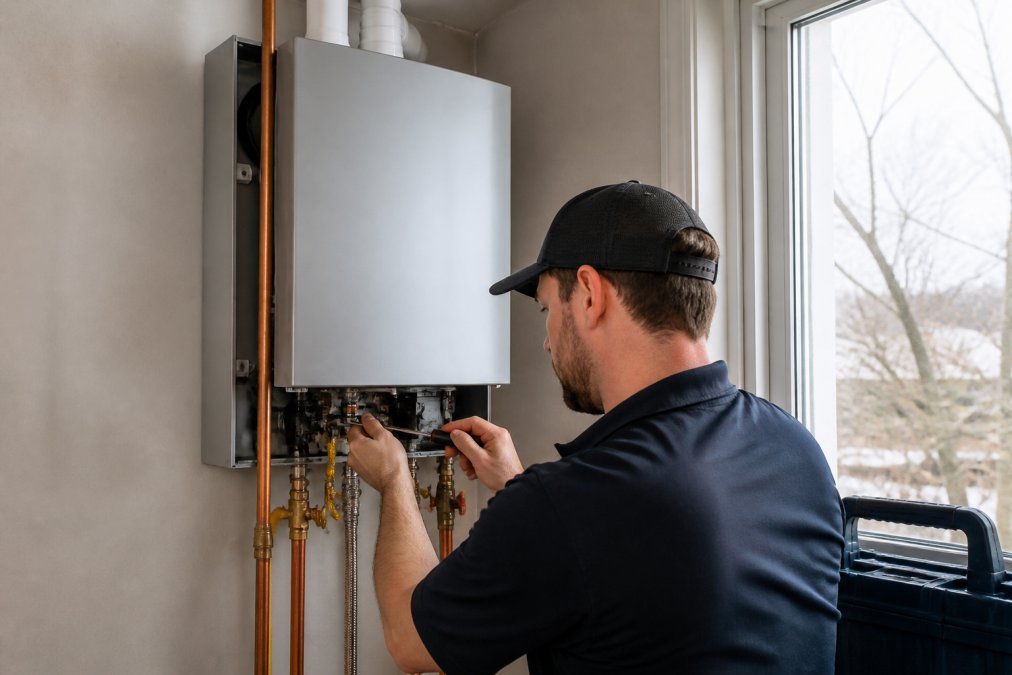
 comparison
Is a Tankless Water Heater Worth It in Canada?
Table of Contents
- How Tankless Water Heaters Work
- Tank vs Tankless Water Heater Efficiency
- Tankless Water Heater Installation Cost in Canada
- Maintenance Requirements for Tankless Water Heaters
- Performance in Cold Climates and Hard Water Conditions
- Is a Tankless Water Heater Worth It for Your Home?
- Frequently Asked Questions
Last Updated: September 20, 2026
How Tankless Water Heaters Work
A tankless water heater heats water on demand without storing it in a tank. Unlike traditional storage tank systems that maintain constant temperature, tankless units activate only when hot water is needed, then shut off once demand stops.
Cold water enters the unit and passes through a heat exchanger, either a gas burner or electric heating element, that rapidly raises the water temperature. Flow rate sensors trigger the heating mechanism, and heated water exits immediately to your fixtures.
Most tankless units run on natural gas, delivering higher flow rates and better cold-climate performance for larger households. Electric models suit point-of-use applications like a single bathroom but struggle with whole-home demand.
The compact wall-mounted design takes a fraction of the space a typical storage tank requires, ideal for homes with limited utility room space.
Tank vs Tankless Water Heater Efficiency
The efficiency difference comes down to standby heat loss. Traditional storage tanks continuously maintain water temperature even when unused, wasting energy on idle water.
Tankless systems eliminate standby heat loss, producing heat only when needed. This translates to lower utility bills for most households, though savings depend on daily hot water usage.
Energy efficiency ratings differ between technologies. Storage tanks typically achieve 55-65% thermal efficiency, meaning roughly 55-65 cents of every dollar spent on heating goes toward useful hot water. Tankless units often reach 80-90% efficiency, particularly condensing gas models that capture heat from exhaust gases.
However, efficiency doesn't tell the whole story. A tankless system requiring expensive venting upgrades may not deliver better long-term value than a modestly efficient tank system.
In colder regions, groundwater enters at lower temperatures, requiring more energy to reach desired heat. Tankless units in northern climates work harder and consume more fuel, reducing the efficiency advantage.
Tankless Water Heater Installation Cost in Canada
Installation costs vary significantly based on existing infrastructure. A straightforward replacement with existing gas lines and venting typically costs $2,000-$3,500. Homes requiring infrastructure upgrades often see costs climb to $4,500-$7,000 or higher.
Venting and Condensation Handling
Gas tankless units produce condensation requiring dedicated venting, typically a separate PVC or metal pipe through your roof or exterior wall. Upgrading from an existing chimney or flue adds $800-$1,500. Condensate drainage to a floor drain or pump adds another $200-$400.
Gas Line Capacity Assessment
High-capacity tankless units demand more gas flow than storage tanks. If your line is undersized (common in older homes), upgrading to a larger diameter pipe costs $600-$1,200. Request your gas utility's free pressure test to determine if your existing line is adequate before committing to a quote.
Electrical Panel and Circuit Requirements
Gas tankless units need only a small 120-volt circuit costing $150-$300. Electric models require dedicated 240-volt circuits with 50-100 amperage capacity. Panel upgrades cost $1,500-$3,000 and are common in homes built before 1990.
Water Line Modifications
If existing water lines don't reach the proposed location, rerouting copper or PEX lines adds $300-$800. Alternatively, a point-of-use electric unit at a distant bathroom or kitchen sink costs $400-$800 installed.
Permits and Inspections
Most municipalities require permits for tankless water heater installation, particularly if gas lines or venting are modified. Permit costs typically range from $100-$250, and inspections are mandatory before the system can be activated. Budget these into your total cost estimate.
Getting an Accurate Quote
Request quotes from at least two certified plumbers. A thorough quote should itemize equipment, labour, venting upgrades, gas line modifications, electrical work, permits, and inspection fees separately. Ask whether the quote includes a gas line pressure test and electrical load calculation.
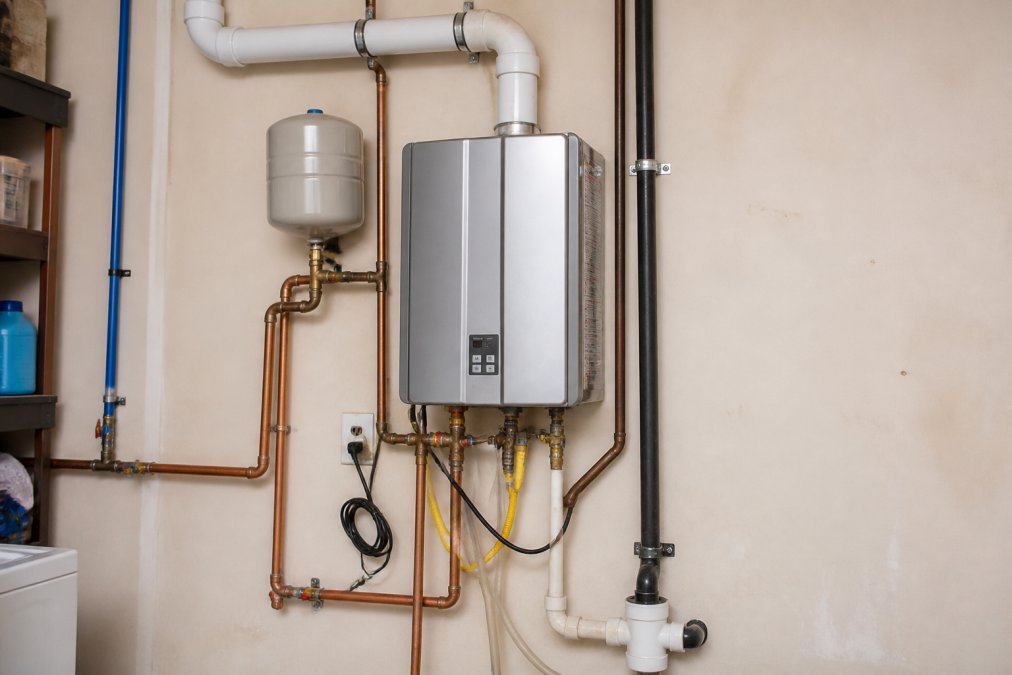
Comparing Total Cost to Storage Tank Replacement
A traditional storage tank replacement typically costs $1,200-$2,000 installed. The cost difference between tankless and tank systems ranges from $1,500-$5,000. Divide this by projected annual energy savings (typically $150-$400) to determine payback period. If it exceeds 15 years, a storage tank may deliver better overall value.
Maintenance Requirements for Tankless Water Heaters
Tankless water heaters require regular descaling to maintain performance and longevity. Hard water deposits accumulate on the heat exchanger, reducing efficiency and potentially causing failure. Descaling frequency depends directly on water hardness.
Descaling Frequency and Cost
Water hardness is measured in parts per million (ppm) of dissolved minerals. Below 100 ppm, descaling every 3-4 years costs $150-$250 per service. Between 100-200 ppm requires annual descaling at $150-$250 yearly. Above 200 ppm, common in Alberta, Saskatchewan, and Ontario, demands descaling every 6-12 months at $300-$500 annually.
Some homeowners perform descaling themselves using a descaling kit (typically $50-$100) and following the manufacturer's instructions. This requires connecting the kit's pump to the unit's service ports and running a food-grade citric acid or proprietary descaling solution through the heat exchanger for 30-45 minutes. However, improper descaling can damage the unit, so many manufacturers recommend professional service to maintain warranty coverage.
Water Softening as a Preventive Strategy
Installing a whole-home water softener alongside a tankless unit significantly reduces descaling frequency and extends equipment lifespan. A water softener removes calcium and magnesium ions before they reach your water heater, preventing mineral buildup entirely. A whole-home water softener costs $1,200-$2,500 installed and requires periodic salt refills (approximately $50-$100 per year). For households with water hardness above 200 ppm, the softener pays for itself within 5-7 years through avoided descaling costs and extended tankless unit life. Many homeowners find this investment worthwhile when combined with a tankless system purchase.
Annual Professional Inspections
Annual professional inspections catch problems early and are strongly recommended by manufacturers to maintain warranty coverage. A technician checks gas connections for leaks, verifies venting integrity, inspects electrical components, and confirms the unit operates at proper temperature and flow rate. Annual inspections typically cost $100-$150 and often include a partial descaling or flush. Some plumbers offer maintenance plans bundling annual inspections with descaling at a discounted rate (typically $250-$400 per year), which can reduce per-service costs if you have hard water.
Comparing Maintenance to Storage Tank Systems
Storage tank systems require less frequent descaling but have their own maintenance demands. Tank flushing removes sediment buildup and typically happens every 1-2 years, costing $100-$150 per service. Anode rods in storage tanks need replacement every 3-5 years to prevent rust and corrosion, costing $150-$300 per replacement. Over a 15-year lifespan, storage tank maintenance costs roughly $1,500-$2,500 total. Tankless systems with hard water may cost $2,000-$3,000 in maintenance over the same period, though this varies significantly based on water hardness and whether a softener is installed.
Lifespan and Warranty Considerations
Well-maintained tankless systems often last 20+ years, while storage tanks typically last 10-15 years. This longer lifespan offsets higher upfront costs for many households, though maintenance discipline is essential. Most tankless manufacturers offer 10-15 year warranties on the heat exchanger (the most expensive component) if annual maintenance is documented. Skipping maintenance voids this warranty, leaving you vulnerable to a $1,500-$3,000 heat exchanger replacement. Storage tanks typically carry 6-10 year warranties and are usually replaced rather than repaired when they fail.
Federal and Provincial Rebate Programs
The federal government's Greener Homes Grant program provides up to $5,000 in rebates for energy-efficient home upgrades, including tankless water heater installation. To qualify, you must complete a pre-retrofit energy audit (approximately $300-$600 out-of-pocket, partially rebated) and hire a certified contractor to perform the work. The rebate covers up to 50% of eligible costs, capped at $5,000. Eligibility and rebate amounts vary by province; British Columbia, Ontario, and Quebec offer additional provincial incentives. Check the Natural Resources Canada website for current program details and your province's specific offerings. These rebates meaningfully improve the financial case for tankless conversion, potentially reducing net installation costs by 20-40% for eligible households.
Performance in Cold Climates and Hard Water Conditions
Cold groundwater temperatures significantly impact tankless performance. In winter, groundwater entering your system is much colder than summer temperatures. A unit sized for summer demand may struggle to meet hot water needs in January, particularly if multiple fixtures run simultaneously.
This means households in colder regions often need larger, more expensive units to maintain performance year-round.
Is a Tankless Water Heater Worth It for Your Home?
At UMark Plumbing and Drain Inc., we assess homes to determine whether tankless conversion makes sense for their specific situation. The answer is never one-size-fits-all. A thorough evaluation of your water demand patterns, home infrastructure, and local water quality provides the clarity needed to make a confident decision.
Frequently Asked Questions
What do plumbers say about tankless water heaters?
Most plumbers recognize that tankless water heaters offer genuine energy efficiency benefits and space savings, but emphasize the importance of proper installation and climate-appropriate sizing. They note that performance depends heavily on groundwater temperature, gas line capacity, and venting configuration. Many recommend them for homes with moderate hot water demand, but caution that oversizing or undersizing can lead to flow rate issues or wasted energy.
How much does it cost to install a tankless water heater in Canada?
Installation costs vary significantly based on your home's existing infrastructure, venting requirements, and the unit selected. Gas models typically require more extensive venting and gas line upgrades than electric models. Contact UMark Plumbing and Drain Inc. for a quote tailored to your specific installation needs, this ensures you receive an accurate estimate before committing to the upgrade.
Do tankless water heaters perform well during extreme cold?
Tankless units can struggle in extremely cold climates because groundwater temperature drops significantly in winter, requiring the heater to work harder to reach desired temperatures. High-quality units include freeze protection and are engineered for cold climates. However, performance may still decline in harsh winters, and some households experience reduced flow rates during peak demand in freezing conditions.
What maintenance does a tankless water heater require?
Tankless water heaters require annual descaling to remove mineral buildup from hard water, this is more frequent than tank-based systems. They also need periodic filter cleaning and professional inspection to ensure heat exchanger efficiency. In regions with very hard water, descaling may be needed twice yearly. Regular maintenance extends lifespan and prevents performance degradation, making it essential for long-term cost savings.