 how-to
How to Prevent Commercial Drain Clogs: 7 Proven Steps
Table of Contents
- Signs of a Slow or Blocked Drain You Should Never Ignore
- Step 1: Set Up a Daily Drain Maintenance Routine for Kitchen Staff
- Step 2: Build a Commercial Drain Maintenance Schedule That Works
- Step 3: Meet Grease Trap Cleaning Requirements Before They Cost You
- Step 4: Flush, Treat, and Know What Never Goes Down the Drain
- Step 5: Know When to Call a Professional Plumber
- Hiring a Licensed Commercial Plumbing Contractor: What to Check
- Frequently Asked Questions
Last Updated: September 11, 2026
Signs of a Slow or Blocked Drain You Should Never Ignore
A slow drain is the earliest warning that a blockage is forming, giving you a window to act and prevent commercial drain clogs before a full backup shuts down your kitchen. Water pooling around floor drains, gurgling sinks, and persistent odours are the three signals commercial kitchens report most often; catching them early is the cheapest drain maintenance you will ever do.
Most operators treat a slow drain as a nuisance rather than a symptom. Standing water in a prep sink, a mop basin backing up, or a floor drain that takes minutes to clear all point to grease or organic waste building up inside the line.
Watch for these signs:
- Water pooling around floor drains after a single wash cycle
- A faint sewage smell that returns even after mopping
- Sinks that drain slowly only during peak service hours
- Gurgling from a drain when a nearby fixture runs
Any one of these means partial blockage. Two or more means you likely need a professional camera inspection.
Step 1: Set Up a Daily Drain Maintenance Routine for Kitchen Staff
A daily drain maintenance routine is the single most effective way to prevent commercial drain clogs. It takes about ten minutes per shift and costs nothing beyond staff time. Assign it to a named person on each shift, not "whoever's closing," because shared responsibility means no responsibility.
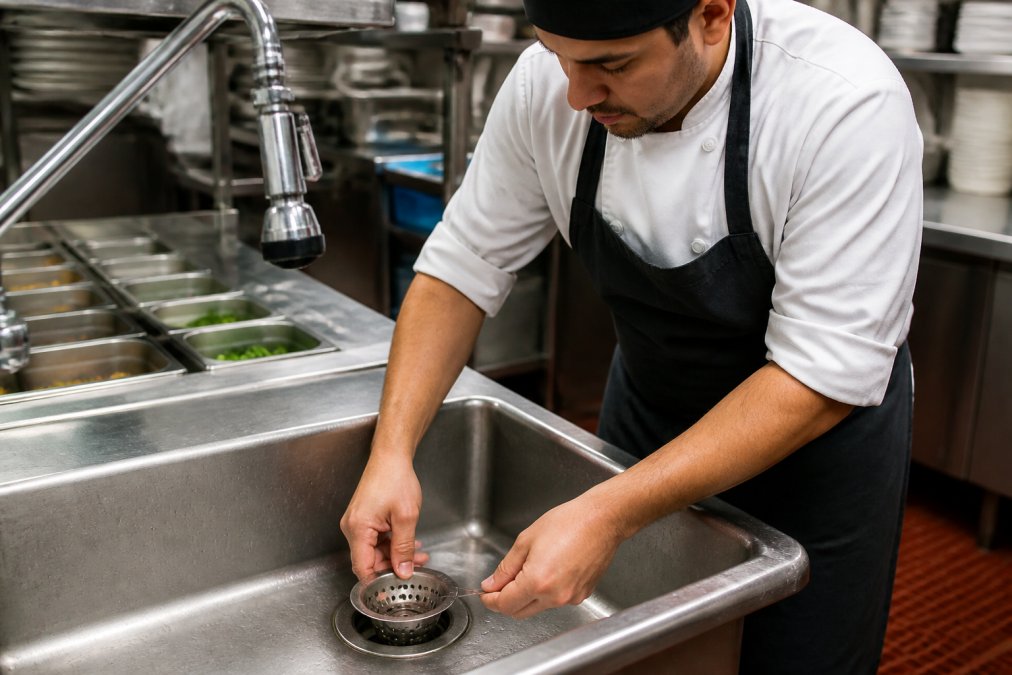
What separates a routine that prevents clogs from one that just looks good on a clipboard is documentation. Public health inspectors in most provinces review maintenance logs during food-safety inspections, and a drain that backs up during service is treated as a sanitation event. A written log with initials and times gives you a defensible record of how you manage FOG and organic waste.
Your routine should cover:
- Clear and rinse all drain strainers and screens after each service
- Wipe down floor drain covers and remove visible debris
- Run hot water through every sink drain for 30 seconds at close
- Log any slow-draining fixture in a shared maintenance sheet
- Empty and rinse the grease collection container before it overflows
- Record the date, time, and initials of the staff member who completed each task
Equipment-Specific Prevention: Floor Drains, Sink Drains, and Dishwasher Lines
Most guides treat "the drain" as one thing. In a commercial kitchen, it is at least three systems with different failure modes, and prevention has to match the fixture.
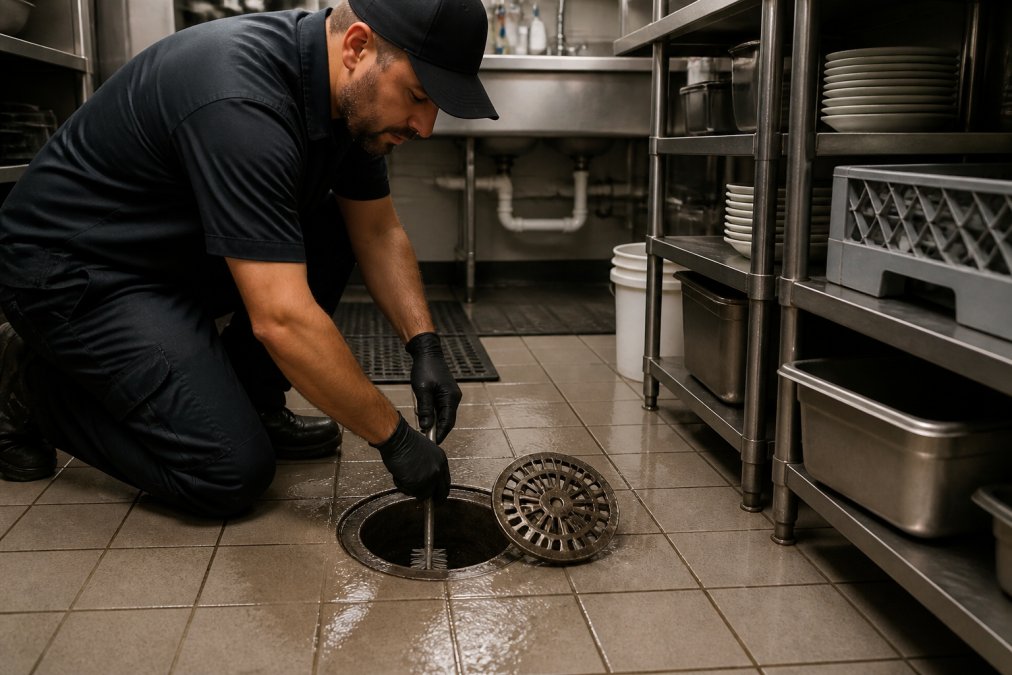
Floor drains are the most neglected and the most likely to cause a shutdown. They collect mop water, food debris, and grease that cools as it hits the trap, and because they see low flow, solids settle instead of being carried away. Beyond wiping the cover daily, lift the grate weekly, remove the debris basket if fitted, and flush with hot water. Walk-in cooler and dish pit drains need the same treatment but are often missed.
Sink drains in prep, handwash, and three-compartment sinks are the highest-volume fixtures. They need strainers sized to the fixture, emptied into the bin, not tapped against the sink edge where scraps fall back in. A produce-washing three-compartment sink loads the drain with fibrous trimmings; a handwash sink rarely clogs unless staff dump drinks or grease into it, which is a training issue, not a plumbing one.
Dishwasher drainage is the most overlooked fixture because the machine appears to handle its own waste. Commercial dishwashers discharge hot, greasy, food-laden water through a dedicated line, often into a floor sink or directly into the drain. That line needs its own strainer or scrap basket, and the hot discharge lets grease travel further before it cools and coats the walls. If your dishwasher drains slowly, the problem is usually downstream of the machine.
Drain Strainers, Screens, and What Goes in the Bin Instead
Drain strainers and screens are cheap insurance, catching fibrous vegetables, coffee grounds, rice, and food scraps before they enter the line. The staff rule is simple: if it didn't come out of the tap, it goes in the bin, not the drain.
Fibrous vegetables like celery, onion skins, and corn husks are the worst offenders because they wrap around pipe walls and snag other debris. A garburator doesn't solve this; it grinds waste into smaller pieces that still settle and accumulate. Rice and pasta look soft but swell with water and form a paste that binds debris together.
Staff Training: The Part That Makes or Breaks the Routine
A routine written on a wall poster fails within two weeks. What works is training that explains the why, not just the what. Walk new kitchen staff through the drain routine during onboarding, where the strainers live, where the log is kept, who to tell when a drain slows, and reinforce it with a short weekly pre-shift reminder.
The most common training gap is assuming "the dishwashers handle it." In practice, prep cooks, line cooks, and servers all put things down drains, so anyone who pours anything into a sink or floor drain owns part of the routine. Make that explicit.
Step 2: Build a Commercial Drain Maintenance Schedule That Works
A commercial drain maintenance schedule pairs daily staff habits with periodic professional service. Daily tasks handle surface debris; scheduled service handles what builds up below the water line. Most facilities need quarterly professional attention at minimum, with high-volume kitchens on a monthly cycle.
| Frequency | Task | Who Does It |
|---|---|---|
| Every shift | Clear strainers, flush with hot water | Kitchen staff |
| Weekly | Enzyme treatment on all drains | Kitchen staff |
| Monthly | Inspect grease trap, check flow rates | Facility manager |
| Quarterly | Professional hydro-jetting and camera inspection | Licensed plumber |
| Annually | Full pipe descaling and integrity check | Licensed plumber |
The schedule only works if someone owns it. Post it near the dish pit, initial it daily, and review it at your weekly operations meeting. A schedule nobody checks is a schedule nobody follows.
Step 3: Meet Grease Trap Cleaning Requirements Before They Cost You
Grease trap cleaning requirements exist because fats, oils, and grease (FOG) are the leading cause of commercial drain blockages. FOG cools as it travels, coats pipe walls, and hardens into a layer that narrows flow and traps solids; over time, it can close a pipe entirely.
Municipalities across Canada regulate FOG discharge, and health inspectors review grease trap maintenance records during routine inspections (Government of Canada website). Cleaning frequency depends on trap size and volume, but the principle is universal: pump before the trap is more than one-quarter full of grease and solids (EPA guidance on FOG management).
What most guides miss is the link between grease trap maintenance and your drain lines. An overdue trap doesn't just risk a fine; it releases grease into the downstream line, exactly where hydro-jetting becomes necessary. Integrate trap pumping into your commercial drain maintenance schedule so the two never fall out of sync.
Step 4: Flush, Treat, and Know What Never Goes Down the Drain
Hot water flushing is the simplest daily defense against FOG. Run hot water, not warm, through every drain after service to melt grease before it solidifies. Pair this with a weekly enzyme treatment to break down the organic film hot water alone won't remove.
What never goes down the drain:
- Cooking oil, pan grease, or fryer oil
- Coffee grounds, rice, and pasta
- Fibrous vegetable trimmings
- Paper towels, wipes, and "flushable" products
- Eggshells, bones, and heavy food scraps
- Cleaning chemicals in concentrated form
Enzymatic Cleaners vs. Chemical Treatments
Enzymatic cleaners use bacteria and enzymes to digest organic waste and FOG slowly, making them safe for pipes and ideal for routine maintenance. Chemical treatments work faster but can corrode older pipes, damage seals, and create hazardous kitchen fumes. For preventative maintenance, enzymatic cleaners are the better default; save chemical openers for genuine emergencies and never mix them with other products.
For a deeper look at what municipal sewer systems expect from commercial kitchens, the municipal wastewater and FOG guidance outlines how FOG discharge is regulated.
Step 5: Know When to Call a Professional Plumber
Call a professional when a drain backs up twice in a month, when multiple fixtures slow at once, or when standing water won't clear after plunging. These patterns point to a blockage deep in the drain line or main sewer connection, not a surface clog you can handle in-house.
A plunger and a baking soda and vinegar mix handle minor kitchen sink clogs, but they won't clear grease accumulation in a commercial line. Hydro-jetting uses high-pressure water to scour pipe walls clean, and pipe descaling removes hardened mineral and grease scale jetting alone can miss. The wrong method can push grease further downstream and make the next blockage worse.
The Cost-Benefit Case for Preventative Maintenance
Most guides tell you to maintain your drains; few do the math. The financial case is straightforward once you compare the two paths.
A scheduled maintenance visit, hydro-jetting, descaling, or a camera inspection, is a planned expense during business hours that doesn't interrupt service. An emergency call is unplanned, arrives after hours or on a weekend, and carries a service premium. On top of the plumbing bill, a backup during service means lost covers, discarded food, staff hours spent cleaning instead of cooking, and in serious cases, a temporary closure a health inspector may want documented.
The pattern commercial plumbers see is consistent: businesses that book routine service spend less over a year than those that call only when something fails. Exact numbers depend on your volume, menu, and grease load, but the direction is always the same: preventative maintenance converts unpredictable emergency costs into a predictable line item.
To frame it for ownership: track last year's drain-related emergency spend, then compare it to a quoted quarterly maintenance contract. If the emergency total is higher, the contract pays for itself before the first backup you avoid.
Grease Trap Maintenance and Drain Lines Are One System
This is the link most guides miss: your grease trap and drain lines are not separate maintenance items but one system, and neglect in one shows up in the other.
When a grease trap is pumped on schedule, it intercepts FOG before it enters the downstream drain line. When it's overdue, grease passes through and coats the pipe walls beyond the trap, exactly where hydro-jetting and descaling become necessary. A trap more than one-quarter full of grease and solids is already releasing FOG downstream, even if it hasn't overflowed.
Your professional plumber should look at both. A visit that jets the drain line but ignores the trap treats a symptom; one that pumps the trap and inspects the downstream line treats the cause. Ask your contractor to document both, and keep that documentation with your grease trap records for inspection.
Equipment-Specific Triggers for Calling a Pro
Different fixtures fail differently, so the trigger for calling a professional should match the fixture.
- Floor drains: Call when water stands after a single mop bucket, when a persistent odour returns after cleaning, or when the drain gurgles as a nearby fixture runs, signs of a blockage or venting issue in the branch line.
- Sink drains: Call when a sink slows only during peak service (grease rehardening when flow stops), when two or more sinks slow at once (shared line blockage), or when plunging clears the sink but it slows again within days.
- Dishwasher lines: Call when the machine drains slowly, water backs up into it during a cycle, or the receiving floor sink overflows; usually grease and food solids in the discharge line, a job for jetting, not a plunger.
- Main line or sewer connection: Call immediately when multiple fixtures across the building back up at once, when sewage odour is strong and persistent, or when water rises in a floor drain during normal use. This is an emergency, not a maintenance item.
What to Have Ready Before the Plumber Arrives
A professional visit goes faster and costs less when you have the right information ready: your maintenance log, which fixtures are affected and when they started slowing, and the location of your grease trap and cleanouts. Have prior service records on hand so the plumber can see the line's history rather than starting from scratch.
At UMark Plumbing and Drain Inc., our certified team provides 24/7 emergency service and routine maintenance, so a Sunday-night blockage doesn't become a Monday-morning closure.
Hiring a Licensed Commercial Plumbing Contractor: What to Check
Hiring a licensed commercial plumbing contractor protects your business from liability and ensures the work meets code. A licensed contractor carries insurance, pulls permits where required, and documents the work for your records; unlicensed work can void insurance claims and create compliance problems during inspections.
Before you hire, verify:
- Valid trade licence and liability insurance
- Experience with commercial kitchen and grease-laden drain lines
- Written estimate before work begins
- Availability for emergency and after-hours calls
- Willingness to provide maintenance documentation
Ask for a written scope of work and a firm quote before anyone opens a drain; a contractor who won't put the estimate in writing isn't one you want on your plumbing infrastructure. For public-facing facilities, confirm the contractor's work supports your sanitation protocols and any health-code documentation your inspector may request.
Commercial drain clogs rarely appear without warning. They build slowly, through habits your staff repeat every shift and service intervals nobody tracks. The fix is a routine: strainers in every drain, hot water flushes at close, a grease trap on schedule, and a licensed plumber who knows your system before an emergency hits. UMark Plumbing and Drain Inc. brings 20+ years of experience, a certified team, and 24/7 emergency response to commercial properties, with affordable pricing and a track record of 100+ clients served. Get a free quote from UMark Plumbing and Drain Inc. (https://umarkplumbing.com).
Frequently Asked Questions
What is the biggest cause of commercial drain clogs?
Fats, oils, and grease (FOG) are the leading cause. When hot grease is poured down a drain, it cools and hardens on pipe walls, narrowing the drain line until wastewater slows to a trickle. Food scraps, coffee grounds, fibrous vegetables, and starch from rice or pasta add to the buildup. In kitchens without working drain strainers or a regularly serviced grease trap, this accumulation can block a commercial drain in a matter of weeks.
How often should commercial drains be professionally cleaned?
Most commercial kitchens need professional drain cleaning every three to six months, depending on volume and menu type. High-output fryer kitchens may need it quarterly, while cafes with light grease use can stretch to twice a year. Your commercial drain maintenance schedule should combine daily staff habits, weekly hot-water flushing, and scheduled professional hydro-jetting or pipe descaling. A licensed commercial plumbing contractor can assess your drainage system and set a service period that matches your actual usage.
Are chemical drain cleaners safe for commercial plumbing systems?
Caustic chemical cleaners can damage older pipes, accelerate corrosion, and harm the bacteria that enzymatic cleaners rely on. They also rarely clear the full blockage, leaving grease further down the drain line. For commercial plumbing, enzymatic cleaners are a better ongoing option because they digest organic waste slowly and safely. Reserve chemical treatments for emergencies only, and never mix products. If a drain is fully blocked, call a professional rather than pouring more chemicals down a standing water drain.
How does grease trap maintenance prevent commercial drain clogs?
A grease trap captures FOG before it reaches your drain line. When the trap fills past its capacity, grease overflows into the plumbing infrastructure and coats pipe walls, causing slow drainage and eventual sewer backup. Grease trap cleaning requirements vary by municipality and trap size, but most commercial kitchens need pumping every one to three months. Keeping a log of every pump-out helps you pass health inspections and proves due diligence if a blockage occurs.