 how-to
Why Water Pressure Drops When Flushing: Diagnosis & Fixes
Table of Contents
- Is a Pressure Drop During Flushing Normal?
- How Toilet Flushing Affects Water Pressure
- Shower Pressure Drops When Toilet Flushes: Identifying the Cause
- Toilet Tank Not Filling Properly: Diagnosis and Solutions
- Low Water Pressure in House but No Leak: What to Check
- Well Water Pressure Drops When Toilet Flushes: Pump and Tank Causes
- Step-by-Step Diagnostic Process
- When to Call a Plumber
- Frequently Asked Questions
Last Updated: October 6, 2026
Is a Pressure Drop During Flushing Normal?
A brief dip in water pressure when you flush the toilet is common, but there's a difference between normal water pressure drops during flushing and a serious plumbing problem.
When a toilet flushes, it demands a large volume of water in a short time, pulling from your supply line.
However, if water pressure drops severely during flushing, lasts longer than 10 seconds, or happens constantly, something is wrong in your toilet, supply line, or home's water system.
How Toilet Flushing Affects Water Pressure
When you flush, two things happen in sequence: the bowl empties and the tank refills.
The flush valve and water demand
The flush valve opens and releases water from the tank into the bowl, clearing the waste. It stays open for about 3 to 7 seconds.
As the tank empties, your home's water supply feeds it at full capacity. If another fixture runs at the same time, both draw from the same supply line, and pressure drops because the supply can't meet total demand.
Static pressure versus flow rate
Two terms matter here: static pressure and flow rate.
Static pressure is the force of water sitting in your pipes when nothing flows, measured in PSI (pounds per square inch). According to Health Canada's guidelines on drinking water quality, typical municipal water pressure ranges from 40 to 70 PSI, though this can vary by municipality.
Flow rate is how much water moves through your pipes per minute, measured in gallons per minute (GPM). A toilet flush demands 2 to 3 GPM.
The problem isn't always low static pressure. It's often restricted flow.
Shower Pressure Drops When Toilet Flushes: Identifying the Cause
You're in the shower, someone flushes the toilet downstairs, and suddenly you're under a trickle of cold water.
The cause depends on your layout. Start by asking: does the pressure drop happen only in the shower, or in other fixtures too?
If only the shower is affected, the problem is usually localized, an old or partially blocked shower valve, with mineral deposits restricting flow.
Try this test: turn on the kitchen sink to full flow while someone flushes the toilet. If the sink pressure drops significantly, your issue is in the main supply; if not, it's isolated to the shower or upstairs fixtures.
Toilet Tank Not Filling Properly: Diagnosis and Solutions
A toilet that fills slowly or incompletely after flushing signals dropping water pressure or a failing fill valve.
Fill valve inspection and adjustment
When the tank empties, the float drops, opening the fill valve. As the tank fills, the float rises, and the valve closes at the correct level.
To inspect the fill valve:
- Turn off the water supply at the shutoff valve under the toilet
- Remove the tank lid and set it aside carefully
- Look at the fill valve. Is it dripping or leaking?
- Turn the water back on and listen. Does it fill quickly or slowly?
- Check the float arm. Does it move freely without sticking?
If the fill valve sticks or moves slowly, it may need cleaning or replacement; mineral buildup is common in hard-water areas.
If the fill valve looks fine but the tank still fills slowly, the problem is upstream.
Supply line restrictions
The supply line carries water from your home's main shutoff valve to the toilet. If partially clogged, the toilet fills slowly and pressure drops.
Supply line restrictions are usually caused by:
- Mineral deposits (especially in hard-water areas)
- Corrosion inside old copper or galvanized pipes
- A partially closed shutoff valve
Check the shutoff valve first, usually behind or below the toilet. Turn it counterclockwise (open) until it stops; if it was only half-open, opening it fully often restores normal pressure. If it's fully open, the line itself may be restricted; a plumber can isolate and test the supply line, measuring pressure at different points to pinpoint the restriction.
Low Water Pressure in House but No Leak: What to Check
Sometimes pressure drops throughout your entire home, not just during a flush. You notice it at every sink and shower, but there's no visible leak.
Municipal supply versus private well systems
Your diagnosis depends on whether you have municipal water or a private well.
Municipal water: Pressure comes from the water company's main line.
Private well: Pressure comes from your own pump and pressure tank.
For well systems, check these first:
- Is the pump running? Listen for a humming sound near the pressure tank.
- Does the pressure gauge on the tank show a reading? Normal is 40 to 80 PSI.
- Has the pump been running constantly without shutting off? That's a sign of a leak.
If the pump runs constantly, you have a leak somewhere. Even a small hidden drip makes the pump run nonstop and pressure drop.
Pressure regulator and check valve issues
Many homes have a pressure regulator on the main supply line to keep pressure steady. It usually looks like a brass cylinder on the main water line near your shutoff valve. According to Natural Resources Canada, ensuring proper water pressure regulation is key for building efficiency and occupant comfort.
The check valve (one-way valve) prevents backward flow. If it fails, pressure can drop, often with a hissing sound. Both are inexpensive to replace but require a plumber to diagnose and install.
Well Water Pressure Drops When Toilet Flushes: Pump and Tank Causes
If you have a private well, pressure drops during a flush point to your pump or pressure tank.
Pressure tank and well pump diagnostics
Your pressure tank stores water under pressure.
If the tank is failing, it can't hold pressure: the pump runs constantly, pressure drops whenever you use water, and you'll hear it cycling on and off frequently.
To test the tank:
- Turn off the pump at the breaker
- Open a faucet and let water drain
- Wait 30 seconds, then close the faucet
- Listen at the tank. Tap it gently. Does it sound hollow or full?
- A healthy tank has a hollow sound (it contains both air and water)
- A waterlogged tank sounds full (all water, no air)
A waterlogged tank needs replacement by a licensed plumber.
The well pump itself can fail. If it's over 20 years old, it may not deliver enough flow to keep up with demand, especially with multiple fixtures running.
Check valve and pump screen blockages
A check valve on the pump discharge line prevents backward flow into the well. If blocked or failing, pressure drops.
The pump screen filters debris from the well; if clogged, water flow is restricted.
Both are located near the pump and tank. A plumber can inspect and clean them in about an hour.
Step-by-Step Diagnostic Process
Use this process to pinpoint where your pressure problem originates.
Step 1: Identify which fixtures are affected
Test every water-using fixture in your home, one at a time, and note the pressure.
- Kitchen sink
- Bathroom sink
- Shower
If only one fixture has low pressure, the problem is localized to that fixture or its supply line.
Step 2: Check for visible leaks and water levels
Walk your home and look for obvious leaks.
- Check under sinks
- Look at water heater connections
- Inspect the basement or crawlspace for wet spots
If you find a leak, that's your pressure problem. Water is escaping instead of reaching your fixtures.
For toilet-specific issues, remove the tank lid and check the water level. It should reach the fill line (usually about 1 inch below the overflow tube).
If the water level is too low, the fill valve isn't opening fully or the supply line is restricted.
Step 3: Test pressure at different points
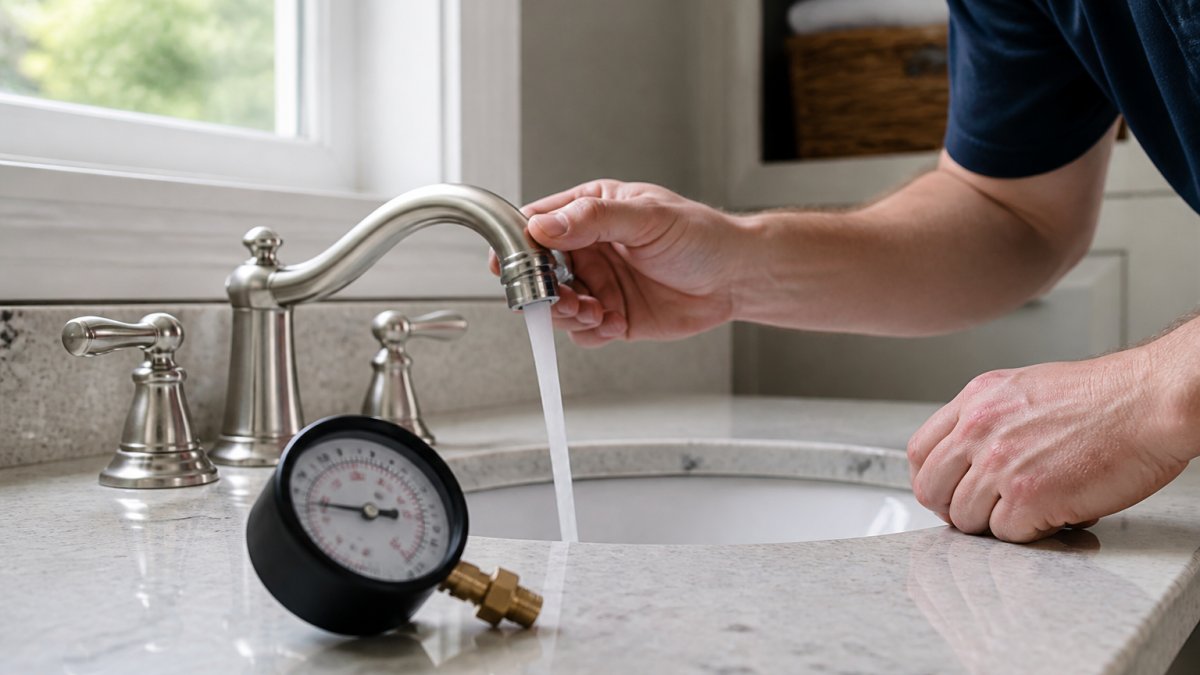
A water pressure gauge costs about $10 to $20 at any hardware store.
- Note the static pressure (when no water is running)
- Note the pressure when the toilet is flushing
- Note the pressure when another fixture is running
If static pressure is below 40 PSI, you have low supply pressure.
If static pressure is normal but drops dramatically during a flush, you have a flow restriction.
If pressure drops at one location but not another, the problem is in that specific line.
Step 4: Inspect the shutoff valve and supply line
Every toilet has a shutoff valve underneath, usually a small knob or handle.
Turn it fully counterclockwise (open). If it was partially closed, opening it may solve your problem.
Look at the supply line: a kink or bend restricts flow.
If the line is over 20 years old, it corrodes internally; replacement often restores normal pressure.
When to Call a Plumber
Call a plumber if:
- Pressure is low everywhere in your home
- The pressure drop is severe (almost no water flow)
- You hear unusual noises (banging, hissing, or constant humming)
You can try yourself if:
- Only one fixture is affected
- The shutoff valve was partially closed
- The fill valve is visibly clogged
UMark Plumbing and Drain Inc. is available 24/7 for emergencies. We can diagnose the issue quickly and restore your water pressure.
A pressure drop when flushing is annoying but fixable. Identify whether the problem is in your toilet, supply line, or home's main system, and the repair is straightforward.
Water pressure problems don't fix themselves. Our certified technicians are available around the clock to restore your water pressure and keep your plumbing running smoothly. Get a free quote and let us handle it today.
Frequently Asked Questions
Is it normal for water pressure to drop when a toilet flushes?
A brief, minor pressure dip is normal; the flush valve opens and draws water from the supply line. However, if the pressure drop lasts more than a few seconds, affects multiple fixtures, or makes your shower unusable, it points to an underlying issue. The difference matters: temporary flow reduction during flushing is expected; sustained low pressure or complete pressure loss indicates a problem worth investigating.
Why does my shower pressure drop when the toilet is flushed?
When the toilet flushes, it pulls water from the same supply line as your shower. If your home has undersized supply lines, a faulty pressure regulator, or a restricted shutoff valve, the demand from the flush can starve other fixtures of water. In well systems, a weak pressure tank or failing pump can't maintain pressure when multiple fixtures draw water simultaneously. Testing pressure at different points helps identify which component is failing.
What should I do if my toilet tank is not filling properly after a flush?
First, check the water level in the bowl and tank. If the bowl is empty, the flush valve may not be closing. If the tank drains but refills slowly, the fill valve is likely restricted or worn. Inspect the fill valve for debris, adjust the float arm if it's set too low, and check the supply line shutoff valve; it may be partially closed. If these steps don't work, the fill valve itself may need replacement. A certified plumber can diagnose and repair this quickly.
Can a clogged pipe or blocked vent pipe cause water pressure to drop when flushing?
A partial blockage in the drain line won't directly reduce water pressure, but a blocked vent pipe can prevent proper drainage, causing the toilet to flush weakly and water to back up. This feels like low pressure but is actually a drainage problem. A blocked vent pipe also affects siphoning action. If pressure seems fine at other fixtures but only the toilet flush is weak, inspect the vent pipe on your roof or have a plumber check for partial clogs in the drain.