 blog
5 Best Pipe Insulation Materials for Cold Basements
Last Updated: October 22, 2026
Quick Summary
Closed-cell foam is the best pipe insulation for cold basements because its sealed cells block moisture and keep their insulating value in humid air. Rubber is the top pick for condensation control on chilled lines, while fiberglass and mineral wool suit hot-water lines only.
- Polyethylene foam is the budget option for dry, accessible cold-water runs but traps moisture in damp basements.
- A 1/2-inch closed-cell foam sleeve provides roughly R-2 to R-3, and a 1-inch sleeve roughly R-4 to R-6.
- Use 3/4-inch or 1-inch foam on pipes against exterior walls or in unheated crawlspaces.
- Tape every seam and butt joint with moisture-resistant tape overlapped at least 1 inch on each side.
- Insulate valves, elbows and fittings as carefully as straight runs, since pipes freeze there first.
Table of Contents
- Why Cold Basements Need the Right Pipe Insulation
- 1. Closed-Cell Foam Pipe Insulation
- 2. Polyethylene Foam Insulation
- 3. Rubber Pipe Insulation
- 4. Mineral Wool Insulation
- 5. Fiberglass Pipe Insulation
- Foam Pipe Insulation vs Fibreglass: Which Wins in a Cold Basement?
- How to Insulate Basement Water Pipes: Step-by-Step
- Frequently Asked Questions
Why Cold Basements Need the Right Pipe Insulation
A cold basement is one of the most common places for water pipes to freeze, and the material you wrap around them decides whether they survive a deep cold snap. At UMark Plumbing and Drain Inc., we have over 20 years of experience.
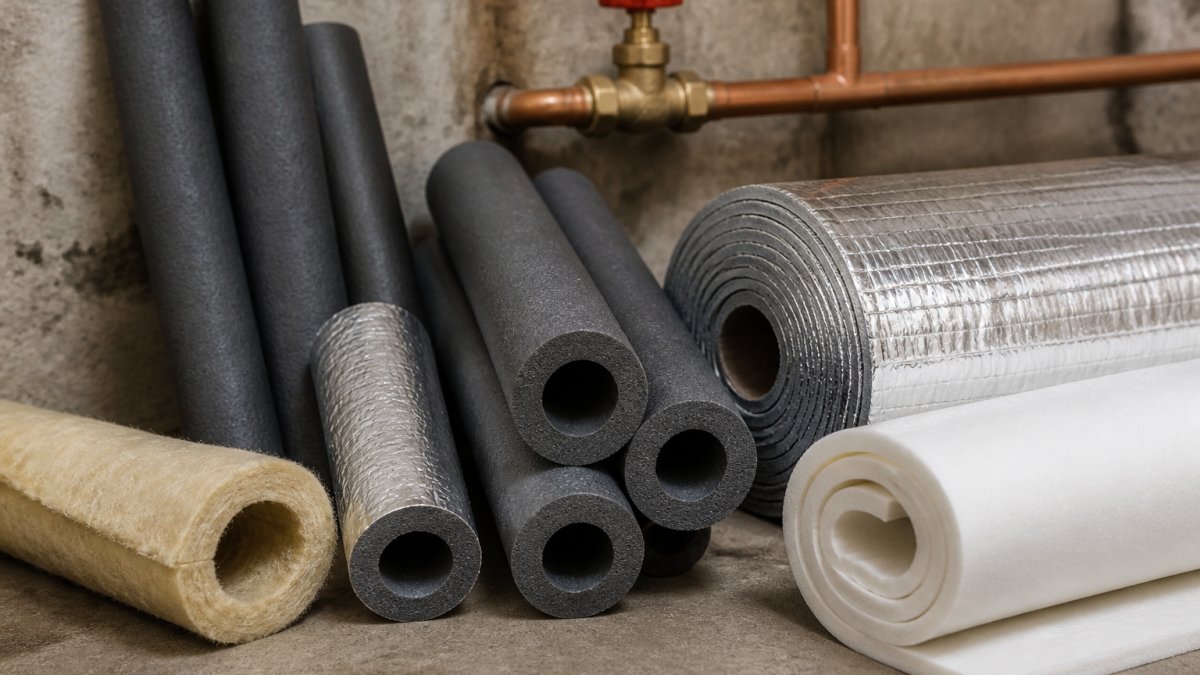
Pipe insulation is a protective sleeve or wrap that slows heat transfer between a pipe and the air around it, keeping water above freezing in winter and preventing condensation in summer. Closed-cell foam, polyethylene, rubber, mineral wool and fiberglass all do this job, but they handle cold, damp basements very differently.
Below, we break down each material, where it fails, and how to choose.
1. Closed-Cell Foam Pipe Insulation
Closed-cell foam is the strongest all-round pick for cold basement water pipes. Its sealed cell structure blocks moisture from soaking in, which matters in a basement where damp air and condensation are constant, and it keeps its insulating value even when the air is humid.
A comparative study on insulating materials indexed by PubMed Central examined mineral wool, polyethylene foam and expanded polystyrene specimens, showing that material choice genuinely changes how a pipe insulation performs. That is why we do not treat all foam as equal.
Pros and Cons of Closed-Cell Foam
- Pros: Excellent moisture resistance, stable thermal resistance, easy to cut and seal, works on both metal and plastic pipes
- Cons: Costs more than basic polyethylene, can crack under UV light if left exposed, seams still need tape
2. Polyethylene Foam Insulation
Polyethylene foam is the budget-friendly option, and it suits cold-water lines in basements that stay dry. It comes as pre-slit tubes that snap over the pipe, so a homeowner can wrap a run in minutes without special tools. Angi's guide to pipe insulation materials notes that foam insulation is suitable for cold-water lines, which is exactly the case in most basements.
Where Polyethylene Works Best
Use polyethylene on straight, accessible runs of cold-water pipe where the basement is dry and the pipe is not exposed to harsh temperature swings. Skip it on hot-water lines and on pipes near a damp floor or weeping wall, where open-cell structure can trap moisture.
3. Rubber Pipe Insulation
Rubber insulation, usually sold as flexible elastomeric tubing, is the go-to for condensation control. Its closed-cell rubber skin resists moisture and does not sweat the way bare metal does, solving a problem foam sometimes only masks.
The trade-off is temperature range. Rubber is not built for high-heat lines, so keep it on cold-water and chilled runs. It also costs more than polyethylene, and fittings and elbows need pre-formed covers or careful cutting to stay sealed.
4. Mineral Wool Insulation
Mineral wool is the choice when heat matters more than moisture. It withstands high temperatures and adds soundproofing, which helps in a basement with noisy pipes or a nearby mechanical room.
The weak point is water. Mineral wool absorbs moisture, so it needs a vapor barrier and a dry environment to perform. In a damp basement, wrap it carefully and keep it off the floor.
5. Fiberglass Pipe Insulation
Fiberglass is the traditional wrap, widely available and effective on hot-water pipes and heating lines. The catch is handling and moisture: fiberglass needs gloves and a mask to install, and once it gets wet it loses thermal resistance and stays damp.
For cold basement water pipes, fiberglass is rarely our first recommendation. It works when properly wrapped with a vapor barrier, but foam and rubber beat it on moisture resistance and ease of installation.
Foam Pipe Insulation vs Fibreglass: Which Wins in a Cold Basement?
For cold basement water pipes, foam wins. Foam pipe insulation vs fibreglass comes down to moisture: foam resists it, fiberglass absorbs it. A wet fiberglass wrap insulates poorly and can hold dampness against the pipe, while closed-cell foam keeps its thermal resistance in humid air.
The right material and thickness depend on the pipe type, the water temperature, and how cold the basement gets. Use this framework to decide.
Match the material to the pipe and the temperature
- Cold-water lines (below 70°F / 21°C): Closed-cell foam or rubber. These materials resist condensation and keep their insulating value in damp air. Polyethylene foam is acceptable on dry, accessible runs but is less forgiving in humid basements.
- Hot-water lines (above 100°F / 38°C): Fiberglass or mineral wool. These materials tolerate heat and are less likely to degrade or soften. Rubber and polyethylene are not rated for high-heat lines and can soften or fail.
- Chilled-water or air-conditioning lines: Rubber (elastomeric) is the standard choice because it handles cold surfaces and condensation without sweating.
Choose thickness and R-value based on your basement conditions
R-value measures thermal resistance; higher R-value means better insulation (Ratings and certification). You rarely see R-values printed on sleeves, but you can estimate: a 1/2-inch (13 mm) closed-cell foam sleeve typically provides roughly R-2 to R-3, while a 1-inch (25 mm) sleeve provides roughly R-4 to R-6. One-inch fiberglass is typically around R-4.
Use these practical criteria:
- Sheltered runs in a basement that stays above 50°F (10°C): 1/2-inch (13 mm) foam is usually sufficient.
- Runs against exterior walls or in unheated crawlspaces: Step up to 3/4-inch (19 mm) or 1-inch (25 mm) foam, or use fiberglass with a vapor barrier.
- Pipes that are likely to see sustained temperatures below 20°F (-7°C): Use the thickest sleeve that fits the space, and consider heat tape in addition to insulation on the most exposed runs.
When a vapor barrier matters
On cold pipes, the goal is to keep warm, moist basement air from reaching the cold pipe surface, where it condenses and drips. Closed-cell foam and rubber are inherently vapor-resistant, so they need no separate barrier as long as seams are taped. Fiberglass and mineral wool are vapor-permeable; on cold lines they need a vapor-tight jacket or wrap with every seam sealed.
A quick comparison by pipe type and condition
| Material | Best For | Moisture Resistance | Handles Heat | Ease of Install |
|---|---|---|---|---|
| Closed-cell foam | Cold water pipes, damp basements | High | Low | Easy |
| Polyethylene foam | Dry cold-water runs | Medium | Low | Easy |
| Rubber | Condensation control, chilled lines | High | Low | Moderate |
| Mineral wool | Hot lines, soundproofing | Low | High | Moderate |
| Fiberglass | Hot-water, heating lines | Low | High | Moderate |
How to Insulate Basement Water Pipes: Step-by-Step
Insulating basement water pipes takes a few hours for a typical run and needs only a knife, tape and the right sleeves. What separates a job that survives a deep freeze from one that fails at the first cold snap is how you handle the weak points: fittings, valves, elbows, and the transitions where pipes pass through walls or floors.
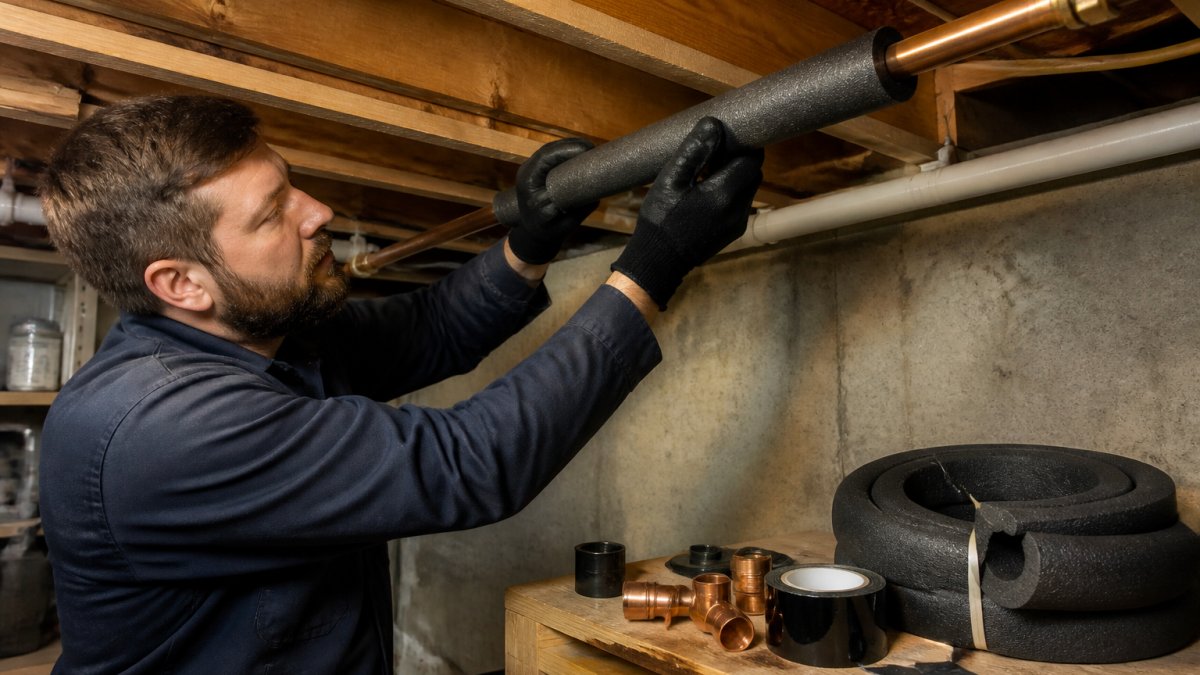
1. Measure the pipe diameter and choose the right wall thickness
Sleeves must fit snugly, not loosely. Measure the outside diameter of the pipe (not the nominal size) and match it to the insulation's stated inner diameter. For thickness, use at least 1/2 inch (13 mm) on runs exposed to cold air, and step up to 3/4 inch (19 mm) or 1 inch (25 mm) on pipes against exterior walls, in unheated crawlspaces, or anywhere the pipe is likely to see sustained temperatures below 20°F (-7°C).
2. Cut sleeves to length and dry-fit the full run
Cut sleeves to length with a sharp knife and slit them along the seam if they are not pre-slit. Dry-fit the entire run before taping anything so you can spot elbows, valves, and offsets that need pre-formed covers or mitred cuts.
3. Insulate the straight runs first, then the fittings
Wrap the full run, but leave the fittings for last so you can work around them without compressing the straight-run insulation. For elbows, use pre-formed covers sized to the pipe; if none are available, make a mitred cut (45 degrees on each sleeve end) so the pieces meet cleanly. For valves, use a pre-formed valve cover or a removable insulation blanket so the valve stays accessible.
4. Tape every seam and joint, including butt joints
Tape every seam and joint so no cold air reaches the pipe. Use a moisture-resistant tape (not masking tape) and overlap it by at least 1 inch (25 mm) on each side of the seam. Pay particular attention to butt joints between sleeve lengths: a gap of even a few centimetres lets cold air reach the pipe and creates a freeze point.
5. Seal penetrations and transitions
Where pipes pass through walls, floors, or rim joists, seal the annular space around the pipe with a suitable sealant or foam. This stops cold air from flowing along the pipe into the basement and prevents condensation just inside the penetration. Use a sealant rated for the pipe material and temperature range; for plastic pipes, use a compatible sealant that will not degrade the pipe.
6. Address safety and code considerations
Before you insulate, check clearances. Keep insulation at least 1 inch (25 mm) away from flues, furnace vents, and other heat sources unless it is rated for that temperature, and never wrap it over electrical junction boxes or recessed light fixtures. If your basement has a furnace, water heater, or other combustion appliance, keep insulation clear of combustion air openings and access panels.
If a pipe has already frozen or burst, insulation will not fix it. That is when you call a plumber, and it is exactly the kind of emergency UMark Plumbing and Drain Inc. handles around the clock. Our certified team responds 24/7 for burst pipes and leaks, and we offer free quotes.
Frequently Asked Questions
What pipes should you insulate in a basement?
Insulate every cold-water supply line, especially those running along exterior walls, near foundation vents, or in unheated crawl spaces. Hot-water pipes benefit too, since pipe insulation reduces heat loss and saves energy. Focus on metal pipes first because they conduct cold faster than plastic pipes. Also wrap elbows, valves, and joints, which are the most common freeze points. If a pipe sits within 10 cm of a concrete foundation wall, it needs insulation regardless of material.
How thick should pipe insulation be in a cold basement?
For most cold basement applications, choose pipe insulation thickness of at least 13 mm (1/2 inch) for small-diameter pipes and 25 mm (1 inch) or more for pipes 25 mm and larger. In areas that drop below -10°C, go thicker: 25 to 38 mm on cold-water lines. Thicker insulation raises the R-value and slows heat loss. Match the insulation's inner diameter to the pipe's outer diameter so it fits snugly without gaps.
Can pipe insulation prevent pipes from freezing?
Pipe insulation for preventing frozen pipes slows heat loss but does not generate heat. It buys time during a cold snap, keeping water above freezing longer, but it cannot protect an unheated basement indefinitely. Pair insulation with heat tape on vulnerable runs and keep the thermostat at 13°C or higher. Seal drafts around windows and rim joists. If a pipe has already frozen, call a licensed plumber rather than thawing it with an open flame.
What is the difference between foam pipe insulation and fibreglass?
Foam pipe insulation, whether closed-cell polyethylene or rubber, is flexible, moisture-resistant, and easy to install without protective gear. Fibreglass is cheaper per metre and handles higher temperatures, but it absorbs water once the vapor barrier is breached and requires gloves and a mask to install. For cold basement water pipes, closed-cell foam usually wins because condensation and damp air are common. Fibreglass suits hot-water lines and heated mechanical rooms.
A frozen or burst pipe in a cold basement rarely waits for business hours, and the damage compounds fast once water starts moving. If you are facing a burst line or a pipe that will not thaw, UMark Plumbing and Drain Inc. is ready with 24/7 emergency service, over 20 years of experience, and a certified team that quotes before the work begins. Get your free quote from UMark Plumbing and Drain Inc. and protect your basement before the next cold snap.