 how-to
How Much Should I Pay for an Emergency Plumber?
Last Updated: October 25, 2026
Quick Summary
Expect to pay a call-out fee plus an hourly labour rate, with an emergency surcharge added for nights, weekends, and holidays, plus parts and materials. Ask any emergency plumber for the call-out fee, the hourly rate for your time slot, and a parts range before you authorize work.
- The call-out fee is a flat charge and is not usually refundable once the plumber arrives.
- Many companies bill labour in half-hour or quarter-hour blocks rather than rounding down.
- Weekday daytime runs roughly 7 a.m. to 5 p.m. at the standard rate, with overnight roughly 10 p.m. to 7 a.m. at the steepest tier.
- Shut off the water, kill the power, and clear a path before the plumber arrives to cut job time.
- Tell the technician you authorize work up to a stated dollar figure and anything above needs a new conversation.
Table of Contents
- What an Emergency Plumber Costs and Why It Varies
- Emergency Plumber Call-Out Fee: What You're Paying For
- Emergency Plumber Hourly Rate and How Labour Adds Up
- After-Hours Plumber Rates: Nights, Weekends, and Holidays
- Getting an Emergency Plumber Estimate You Can Compare
- Steps to Take Before the Plumber Arrives
- Red Flags in Quotes and Questions to Ask Before Work Starts
- Requesting Your Emergency Plumbing Quote
- Frequently Asked Questions
What an Emergency Plumber Costs and Why It Varies
What you pay for an emergency plumber depends on when you call, how the company bills, and how much of the bill is labour versus parts. Most plumbing companies charge a call-out fee plus an hourly rate that climbs after hours, on weekends, and on holidays.
There is no single fair price. Two homes with the same burst pipe can see very different invoices because pricing models, urgency, and parts differ.
The Main Parts of an Emergency Plumbing Bill
Every emergency plumbing bill usually breaks into four pieces:
- Call-out or trip fee: a flat charge to get a licensed plumber to your door
- Hourly labour rate: what the work itself costs, billed per hour or part-hour
- Emergency surcharge: an added premium for nights, weekends, and holidays
Some companies quote a flat rate for a defined job, like clearing one blocked drain; others bill labour plus parts. Neither is wrong, but you cannot compare them line by line until you know which one you are looking at.
Every emergency plumbing bill usually breaks into four pieces.
| Bill component | What it covers |
|---|---|
| Call-out or trip fee | Flat charge to get a licensed plumber to your door |
| Hourly labour rate | Work itself, billed per hour or part-hour |
| Emergency surcharge | Added premium for nights, weekends, and holidays |
| Parts and materials | Shut-off valve, pipe section, fittings, or sealant used |
Emergency Plumber Call-Out Fee: What You're Paying For
An emergency plumber call-out fee is a fixed charge covering travel, the truck, tools, and the first chunk of a technician's time. It is not a deposit and is not usually refundable once the plumber arrives, even if the repair turns out to be minor.
The call-out fee and the hourly rate are not the same thing: a low call-out fee can hide a high hourly rate, and the reverse is also true.
Emergency Plumber Hourly Rate and How Labour Adds Up
The emergency plumber hourly rate moves your bill fastest. It applies from the moment work starts, and many companies bill in half-hour or quarter-hour blocks rather than rounding down.
Here is how labour adds up in practice:
- A technician arrives at 11 p.m. and diagnoses a leaking supply line: 20 minutes
- Shutting off water and cutting out the damaged section: 40 minutes
- Fitting the new section and pressure-testing: 45 minutes
That is two hours of labour at the after-hours rate, plus parts. At 10 a.m. on a Tuesday, the hours would be identical but the rate lower.
Labour Versus Parts and Materials
Labour is the technician's time; parts are the physical items used. On most emergency jobs, labour is the bigger share of the invoice, which is why the hourly rate matters more than the price of a valve. Some quotes bundle parts into a flat price so you cannot see the split, fine for budgeting, but ask for the labour-only rate anyway, since it is the only way to compare two companies fairly.
After-Hours Plumber Rates: Nights, Weekends, and Holidays
After-hours plumber rates carry a premium, and that premium is normal. Overnight, weekend, and statutory holiday calls cost more than a weekday daytime visit because the company is paying standby staff, overtime, and a dispatch desk through the night.
If you want to understand how 24/7 availability affects pricing and response, our guide on emergency plumber after hours explains what to expect when you call in the middle of the night.
How the Premium Is Usually Structured
Most companies price after-hours work in tiers rather than a single surcharge. A common pattern looks like this:
- Weekday daytime (roughly 7 a.m. to 5 p.m.): standard hourly rate, standard call-out fee
- Weekday evening (roughly 5 p.m. to 10 p.m.): a modest premium over the standard rate
- Overnight (roughly 10 p.m. to 7 a.m.): the steepest hourly premium, often the highest tier
Exact multipliers vary by company and region, so treat any percentage you see online, including on this page, as a planning guide, not a quote. What matters is asking which tier your call falls into before you authorize work, and getting the answer confirmed in writing or by text.
What the Premium Looks Like on a Real Bill
Suppose a company's standard weekday rate is $120 per hour with a $90 call-out fee, and its overnight rate is 1.5 times standard with a $150 call-out fee. A two-hour overnight job with $60 in parts would land near $150 + (2 × $180) + $60 = $570 before tax; the same job at 10 a.m. on a Tuesday would land near $90 + (2 × $120) + $60 = $390. The labour hours are identical; the time of day moves the bill. These figures are illustrative only, replace them with the numbers your chosen company quotes.
Three Things That Drive the Premium
- Time of day: late-night calls usually carry the steepest surcharge because standby staffing is thinnest.
- Day of week: weekends sit above weekday rates, and Sunday often sits above Saturday.
- Holidays: statutory holidays are typically the highest tier, and some companies add a separate holiday call-out charge on top of the hourly premium.
When Waiting Until Morning Is the Right Call
Not every problem is a true emergency. A slow drip you can contain with a bucket and a closed supply valve can often wait until standard rates apply; a burst pipe, sewage backup, gas smell near a water heater, or leak near electrical panels cannot. The premium is worth paying when the alternative is water damage, mold, or a safety hazard, and money wasted when a shut-off valve and a towel would have held the line until morning.
Getting an Emergency Plumber Estimate You Can Compare
An emergency plumber estimate should state four things: the call-out fee, the hourly rate, the expected hours, and a parts allowance. If any are missing, you cannot compare it to another quote.
Before you compare numbers, read our breakdown of what an emergency plumbing quote should include. It walks through the line items a proper quote carries so you know what to look for.
Use this checklist to compare two estimates like for like:
- Call-out fee stated separately from labour
- Hourly rate stated, including the after-hours tier
- Billing increment named (per hour, half-hour, or quarter-hour)
Two quotes that look similar at the top can differ sharply once you line up those seven items.
Steps to Take Before the Plumber Arrives
What you do in the first ten minutes often decides how big the final bill is. Water damage spreads fast, and every minute of active leaking adds repair scope.
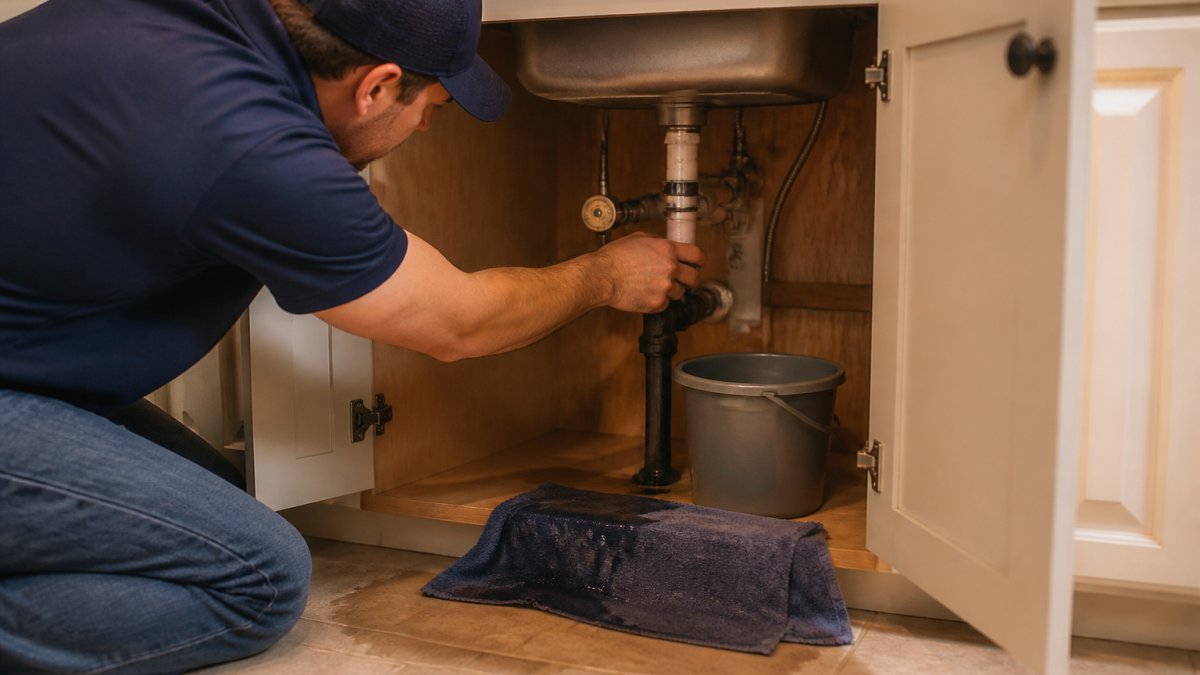
Do these in order:
- Shut off the water. Find the main valve or the fixture's supply valve and close it.
- Kill the power to any area where water is near outlets or appliances.
- Contain the water with towels, buckets, or a wet/dry vacuum.
- Move valuables off the floor and away from the leak.
- Clear a path to the problem so the technician starts work immediately.
- Note what you saw before the leak started, since that detail speeds up diagnosis.
A clear path and a shut-off valve can cut a job from three hours to one. That is real money.
Red Flags in Quotes and Questions to Ask Before Work Starts
A single lump sum with no breakdown is the first warning sign: you cannot verify what you are paying for or compare it to anything.
If you are wondering whether insurance might cover part of the bill, our article on whether emergency plumbing is covered by home insurance covers what policies typically do and do not pay for. Sort that out before you approve work, not after.
A Short Script to Use on the Call
You do not need to be a plumbing expert to protect yourself, just five answers before you say go, asked in this order:
- "What do you think the problem is, and how did you diagnose it?" A technician who can explain the failure in plain language, and show you the failed part, is diagnosing. One who jumps straight to a price is selling.
- "Is this a fixed price or an estimate that can grow?" Get the answer in writing or by text. If it is an estimate, ask what would cause it to grow and by how much.
- "What is the hourly rate and which tier applies right now?" Confirm the after-hours tier and the billing increment (per hour, half-hour, or quarter-hour).
- "What is my approval limit?" Tell the technician you authorize work up to a stated dollar figure and that anything above it needs a new conversation. This single sentence prevents most bill shock.
- "What is the warranty on the parts and the labour, and what are the payment terms?" Get the warranty period and whether it covers both parts and labour. Confirm whether payment is due on completion, whether cards are accepted, and whether a deposit is required.
Recognizing an Unusually High Quote
A high quote is not automatically bad, a genuine 3 a.m. statutory holiday emergency legitimately costs more. But some patterns deserve a pause:
- A price that arrives before any diagnosis. If the number comes before the technician has looked at the problem, it is a guess dressed as a quote.
- A large jump between the phone estimate and the on-site price with no explanation of what changed.
- Pressure to decide in the same minute. Legitimate emergencies exist, but so does urgency as a sales tactic. Ask for ten minutes to read the quote.
If any of those appear, you are entitled to ask for a written breakdown, decline non-urgent work, and, if it is safe to pause, seek a second estimate. If it is not safe to pause, ask the technician to make it safe (shut off the water, isolate the problem) and then decide.
What to Keep for Insurance and Warranty Claims
Whatever you decide, document the visit: keep the itemized invoice, the technician's licence number if shown, before-and-after photos, and any warranty paperwork. If you later claim on home insurance or a product warranty, those records are what the adjuster or manufacturer will ask for. Our guide on how to find reliable emergency plumbers lists the vetting checks worth running before you call anyone out, and the same checks help you decide whether to authorize a second visit from the same company.
Requesting Your Emergency Plumbing Quote
The fastest way to control an emergency plumbing bill is to get the numbers before the truck rolls.
At UMark Plumbing and Drain Inc., we have handled emergency leaks and pipe bursts for more than 20 years with a certified team available around the clock.
Ready to get a number in writing? Request your emergency plumbing quote and we will walk you through what the repair is likely to involve.
Frequently Asked Questions
What does an emergency plumber charge per hour?
Hourly rates for an emergency plumber vary by region, time of day, and the complexity of the repair. Most plumbers charge a higher rate for emergency calls than for standard service, and after-hours or weekend visits typically carry a premium. Ask for the hourly rate and any minimum charge before work begins, and request a written estimate so you can see how labour and parts are separated on the final invoice.
Do emergency plumbers charge more at night or on weekends?
Yes, after-hours plumber rates usually include a surcharge for nights, weekends, and holidays. The premium covers the cost of having a technician available outside standard business hours. If your issue can safely wait until the next business day, scheduling a standard appointment can reduce the total cost. If water is actively leaking or a pipe has burst, call immediately rather than waiting, because delay can cause far more expensive damage.
Should I get an estimate before an emergency plumber starts work?
Ask for an emergency plumber estimate before authorizing any work. A clear estimate should list the call-out fee, the expected labour time, and the parts needed, so you can compare it like-for-like with other quotes. If the plumber cannot provide a breakdown or the final invoice differs significantly from the estimate, ask for an explanation in writing before you pay. A written estimate also helps if you need to make an insurance claim later.
How can I reduce the cost of an emergency plumbing repair?
Shut off the water supply and contain the leak before the plumber arrives to limit damage. Describe the problem clearly when you call so the technician brings the right parts. Ask whether the repair can wait for a standard-rate appointment if it is safe to do so. Finally, keep documentation of the work, including the invoice and any warranty details, so you have a record if the same issue returns.
An emergency plumbing bill should never feel like a guess. Get the call-out fee, the hourly rate, and the parts range in writing before anyone starts work, and you keep control of the cost. Get started with UMark Plumbing and Drain Inc. and get a clear quote before we dispatch, backed by 24/7 availability and a certified team.